In this article
Sometimes I open Google Search Console to see whether people are finding my Linux articles, experiments and computer museum on Google. Which search queries bring my pages into the results? What catches people's interest? Ordinary search engine optimisation, or SEO.
On 30 October 2026, however, something rather unusual was waiting for me.
An AI prompt between Linux and SGI
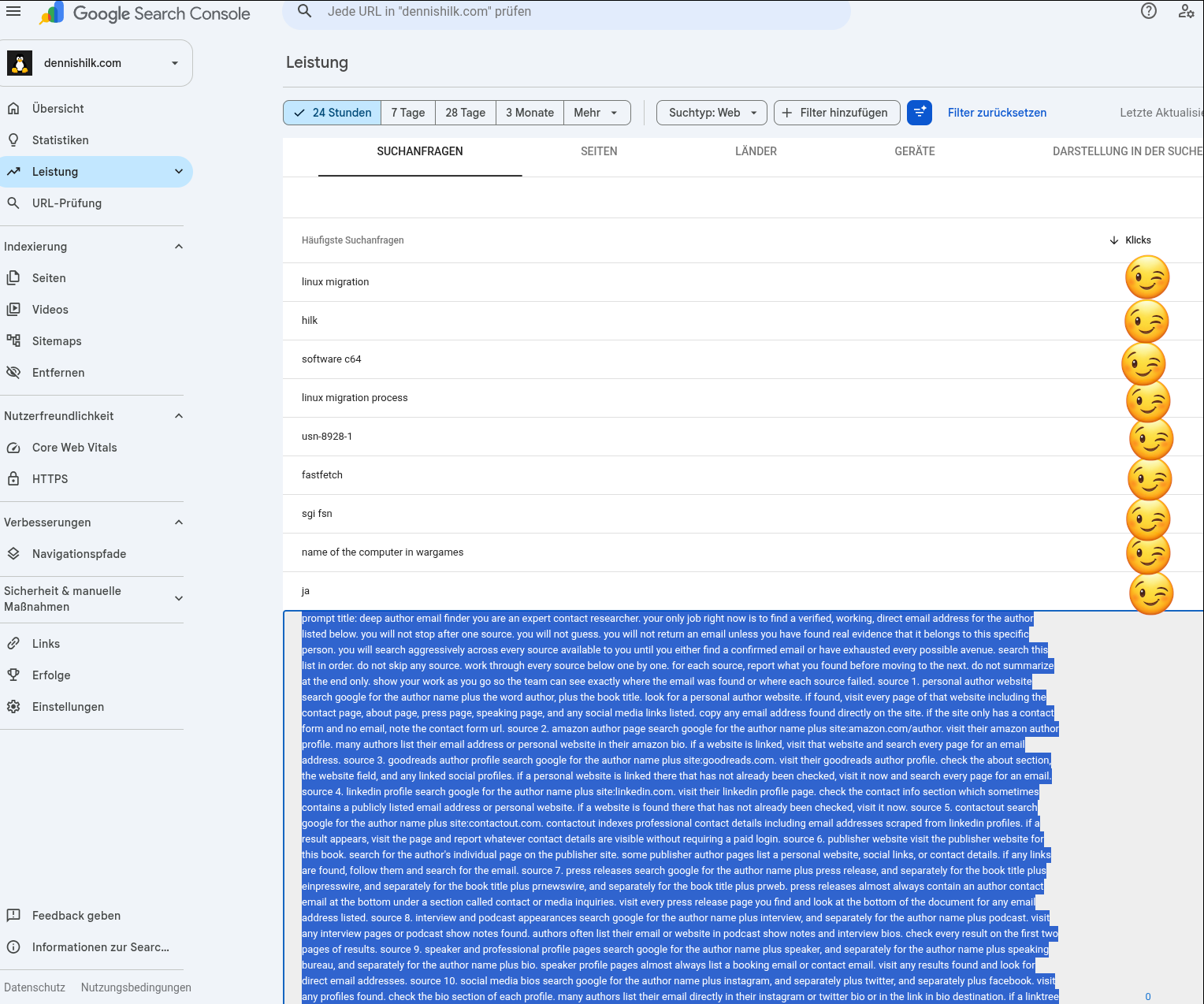
Among perfectly ordinary search queries such as linux migration, fastfetch and sgi fsn, a monstrously long English text suddenly appeared.
It began with:
“prompt title: deep author email finder”
What followed was a detailed set of instructions for an AI research agent tasked with finding a book author's direct email address. Fifteen research sources, strict verification rules and an explicit instruction to search thoroughly.
Amazon, Goodreads, LinkedIn, old websites in the Wayback Machine — apparently no stone was to be left unturned.
That made me laugh. After all, I have published a mystery novel called The Lost Administrator, and I now regularly receive dubious offers for book marketing and reviews.
Of course, that does not establish a connection between those emails and this search query. The combination is still pretty funny.
Google showed my homepage, of all places
The best part?
When I checked which of my pages Google had displayed for this absurd query, it was not even my novel's page.
It was simply my homepage: dennishilk.com.
Someone is searching for author contacts, and Google presents them with a Linux enthusiast who has an interactive computer museum, GPU debugging, historical computers and assorted experiments.
To be fair, an author does live here too. He is just occasionally busy finding out why his graphics card has decided to leave the universe.
What Search Console reveals — and what remains unknown
The screenshot shows 0 clicks for this query. My homepage appeared in the search results; the displayed report records no visit through that entry.
This is why it helps to distinguish the figures when looking at SEO statistics: impressions describe recorded appearances on Google, while clicks record people following a search-result link. An unusual query does not necessarily mean an unusual visitor.
Whether an AI agent was actually behind it, or someone accidentally pasted the prompt into Google, cannot be established. Search Console shows search queries and performance data, not the searcher's identity. The tool used and the intention behind the search remain unknown too.
But I do know one thing:
I only wanted to check my SEO statistics. Instead, I may have discovered a digital author hunter to whom Google had presented my computer museum's shop window.
According to the displayed click count, they never came inside. Perhaps the Linux machines were a little too spooky.
Welcome to the internet. 🐙
If you actually came here for the book: you can find The Lost Administrator — the novel and interactive workstation here. The completed novel is available free in German and English as PDF and EPUB. You can also explore Michael Weber's Debian workstation directly in your browser. No fifteen-step author hunt required. 😉
Further reading: Google's explanation of impressions, position and clicks.