In this article
- Original trailer (1996)
- Florida, a shop window and a birthday present
- What you actually got in the box in 1996
- Why Longbow was technically extraordinary in 1996
- Thirty years later: my real Windows 98 retro PC
- Twenty-five drives, no IDE cable – and a return to SCSI
- Plug and Pray: a blue screen in the Adaptec driver
- 36, 68 or 97 MB: give me maximum terrain detail
- FILES=45, BUFFERS=45 – and “Waidmannsheil!”
- The Apache runs. The Aztech is still silent
- When a game still came with a phone number
- Not everything was better back then. But some things really were.
- A Y2K detour: “More trial days for me!”
- Why this box still makes me happy thirty years later
- Sources and scope
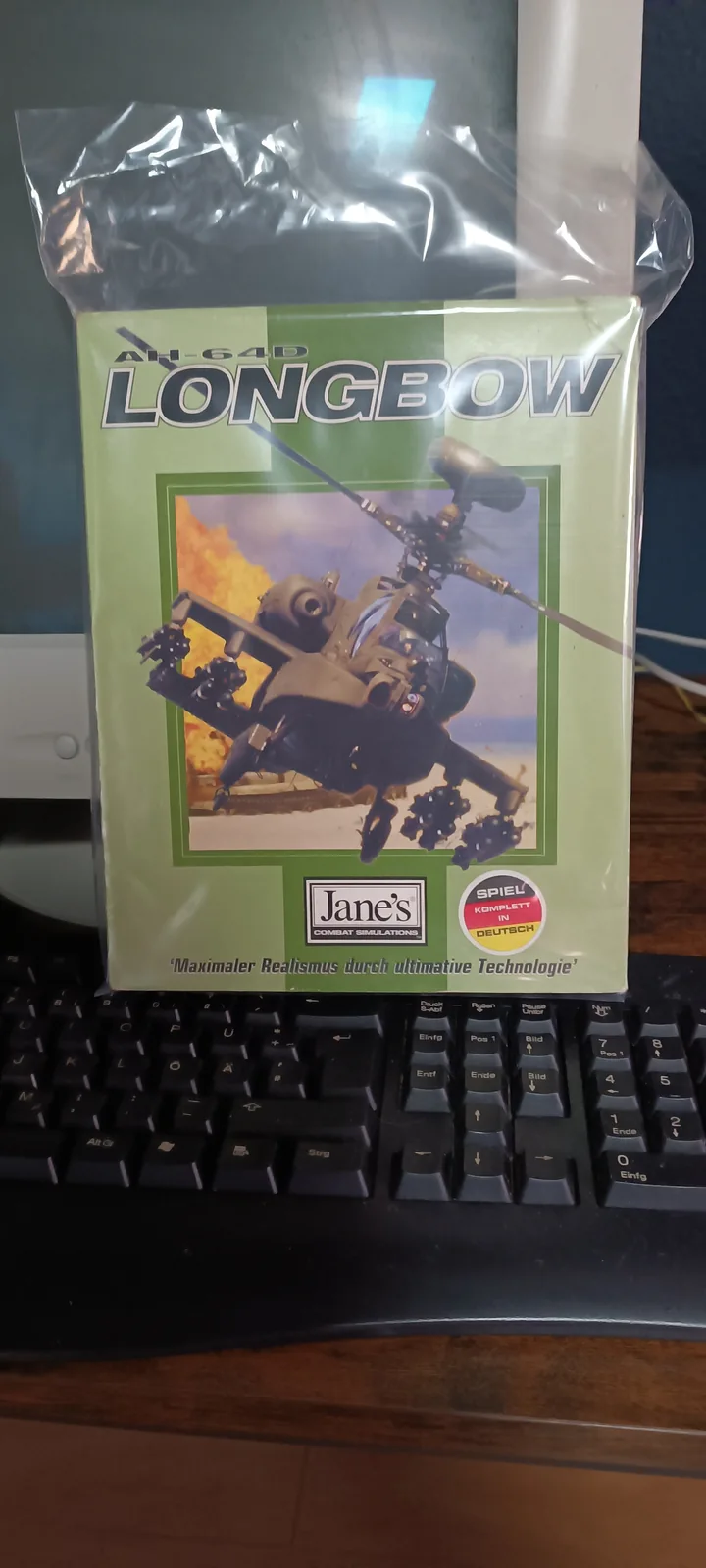
On 3 November 2026 I sat cross-legged on the floor with a large, dark-green box in front of me. Not because my desk was too small. I simply wanted to enjoy the moment properly. I opened the original German edition of Jane’s Combat Simulations: AH-64D Longbow from 1996, placed its weighty ring binder beside the CDs and managed just one word: Woooow.
Sometimes you do not need a time machine. Sometimes the postman will do.
The original 1996 trailer: where the fascination began
Before radar diagrams and retro-PC hardware: here is the entire original trailer, which I captured from my own CD on the retro PC. At around 1:00 you can see the very radar scene that stayed with me since childhood.
And that glorious classic action-TV moment: the missile hits, the enemy tank is destroyed – and the soldier manages to run away just in time. Straight out of The A-Team, MacGyver or Baywatch: the fleeing extra appears perfectly fine. Only the tank is unlucky. 😂
This is historical promotional footage from 1996. Rights to the original trailer remain with the respective rights holders; my capture accompanies this independent retrospective. The embedded video is delivered by YouTube.
Florida, a shop window and a birthday present
My earliest memory of Jane’s AH-64D Longbow goes back, as best I can remember, to a family holiday in Florida. I saw the American edition advertised and probably spotted it in a shop as well. Thirty years later I cannot be certain whether both happened. But I remember the feeling: that Apache was something special.
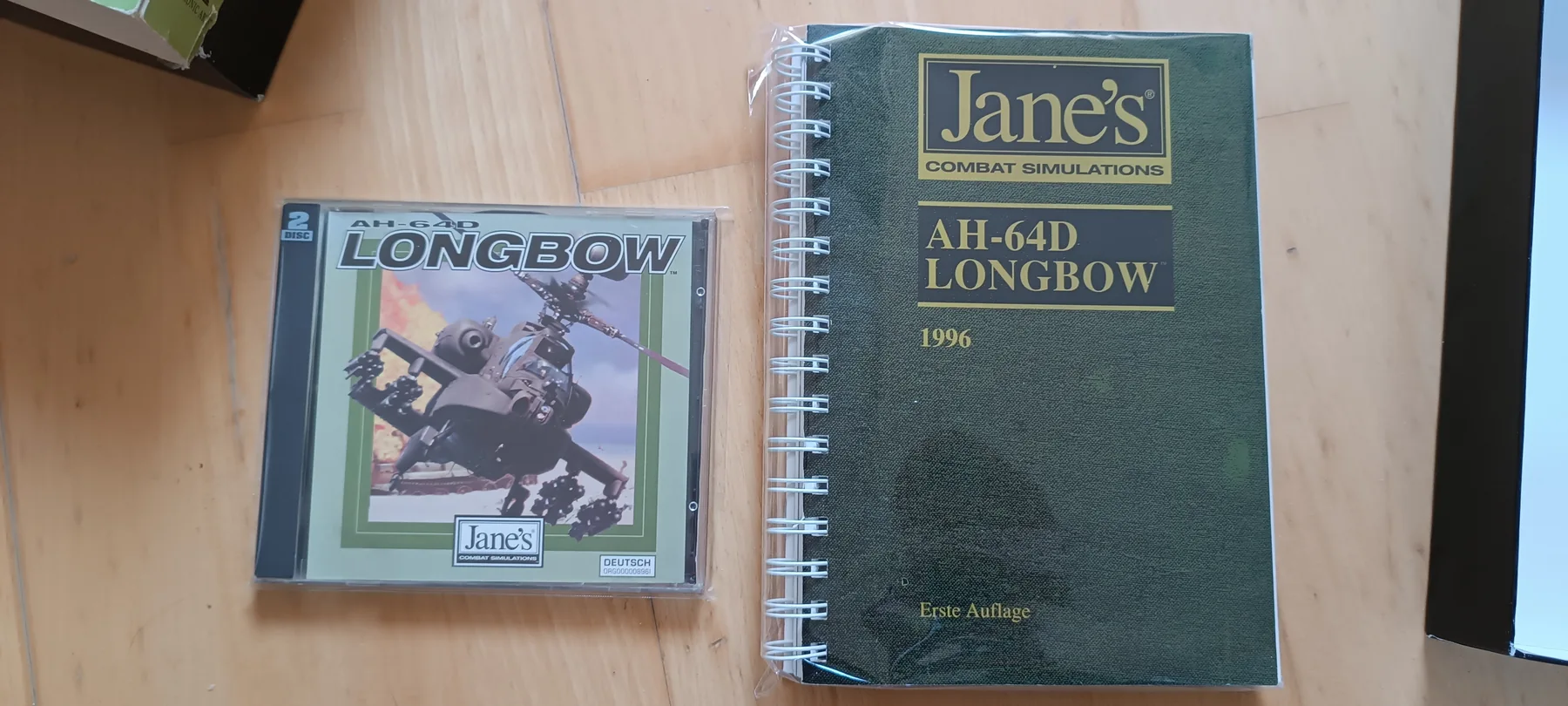
Back home, my parents gave me the German big-box edition for my birthday. Not a download, but a proper package: two discs, reference cards and that extraordinary green Jane’s ring binder. The edition that arrived today is the same German version I knew as a youngster. Its manual looks as if somebody barely touched it for thirty years.
I had read my own copy perhaps a hundred times. It was not merely a way to learn which keys to press. I wanted to understand the instruments, procedures, radar and weapon systems. That was the attraction: a simulation that expected you to learn something about the machine instead of simply putting you in it.
What you actually got in the box in 1996
These days a game box, if one exists at all, may contain little more than a download code. With Longbow, opening the box could occupy an entire afternoon. You read the technical explanations, spread out the keyboard reference, studied cockpit diagrams and wondered how anyone was supposed to operate all of that while flying.
My recovered copy makes the point perfectly: two pressed CDs, a substantial ring-bound manual, fold-out keyboard and cockpit references, printed documentation and inserts. Not reproduction memorabilia but the material people used to learn a serious PC flight simulator in 1996.
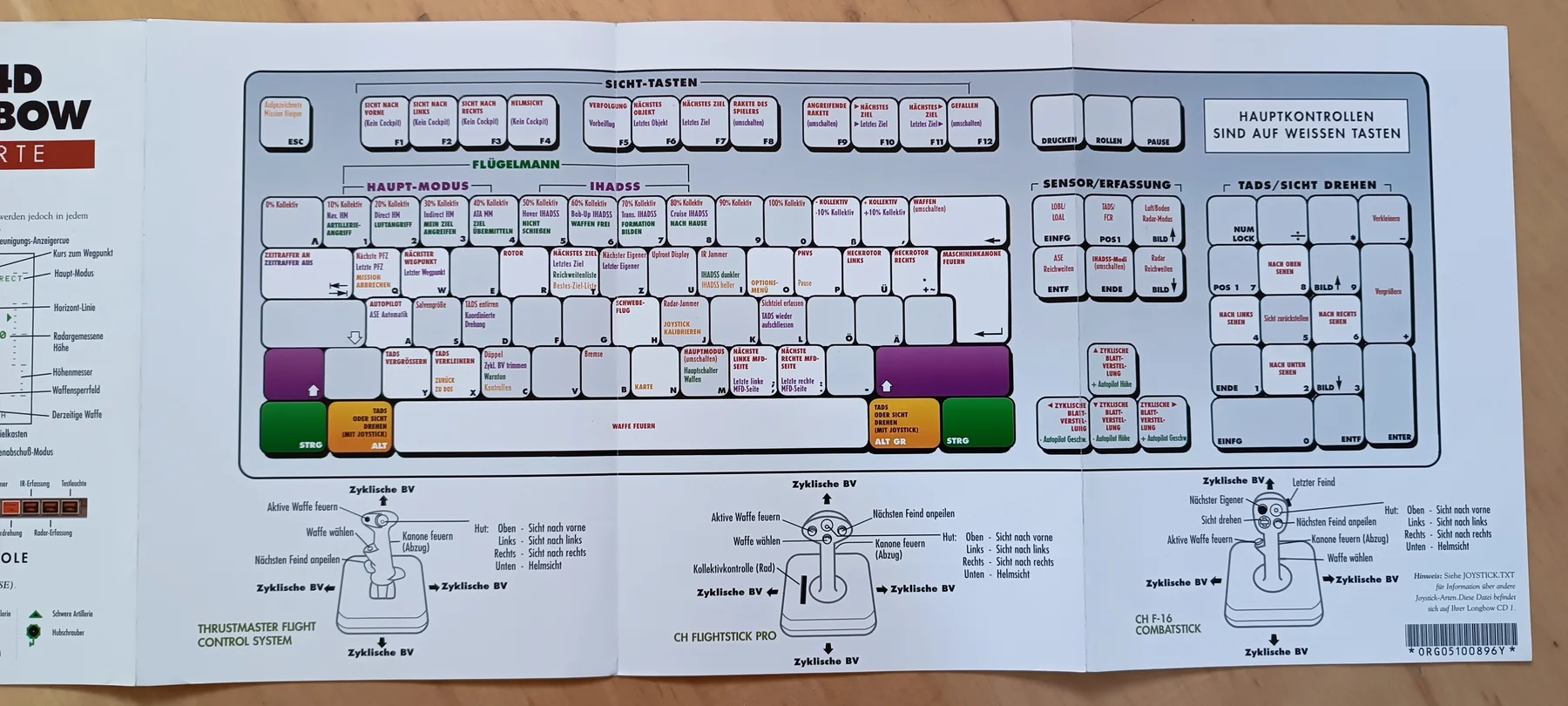
Those unfolded reference sheets are not covered with ten colourful controller icons. They show entire groups of functions. It is both a promise and a warning: you can do an awful lot here, but first you must understand what those commands actually mean.
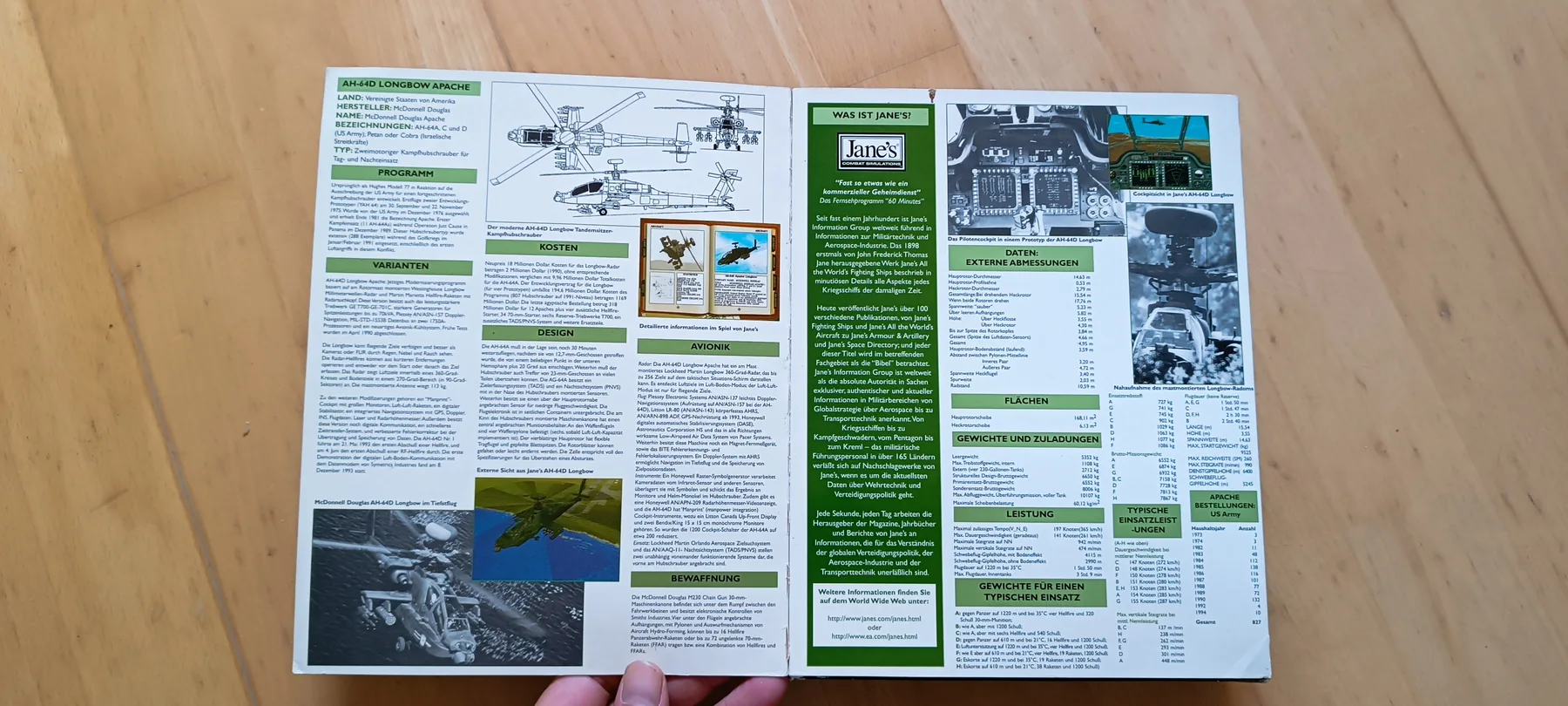
That does not mean every game used to be bigger or better. It means that, for this particular release, software, documentation and packaging formed one experience. The manual was part of the game for me. Opening a near-pristine copy three decades later hit harder than any high-resolution remaster ever could.
Why Longbow was technically extraordinary in 1996
Longbow appeared in 1996, developed by Origin Systems and Origin Skunkworks and published by Electronic Arts. Andy Hollis was its producer, and the Jane’s name signalled an unusually technical approach. Reviews from the period praised the depth of its systems, tutorials, mission variety and impressive contemporary terrain graphics. [1][2][3]
One important distinction: this is the original Longbow from 1996, not Flash Point: Korea, Longbow Gold or Longbow 2. Expansions and sequels changed many of the systems. Features added later should not quietly be credited to the original release. [1][4]
The hill, the radar and the moment that stayed with me
One idea fascinated me more than almost anything else: keeping the helicopter hidden behind a ridge while its mast-mounted Longbow radar peeks over the top. Find targets, assess the situation, briefly leave cover, engage and disappear again. To the younger me, this was the essence of modern technology.
The concept has a real-world basis. The AH-64D can carry millimetre-wave fire-control radar above the rotor mast. Depending on terrain and line of sight, it can detect objects while much of the aircraft remains masked by a ridge. The hill does not make the helicopter magically invisible; Hellfire employment still depends on targeting information, trajectory and engagement conditions. A PC simulation inevitably simplifies these things. But thinking in terms of sensors, visibility and cover was extraordinary in a game of that era.


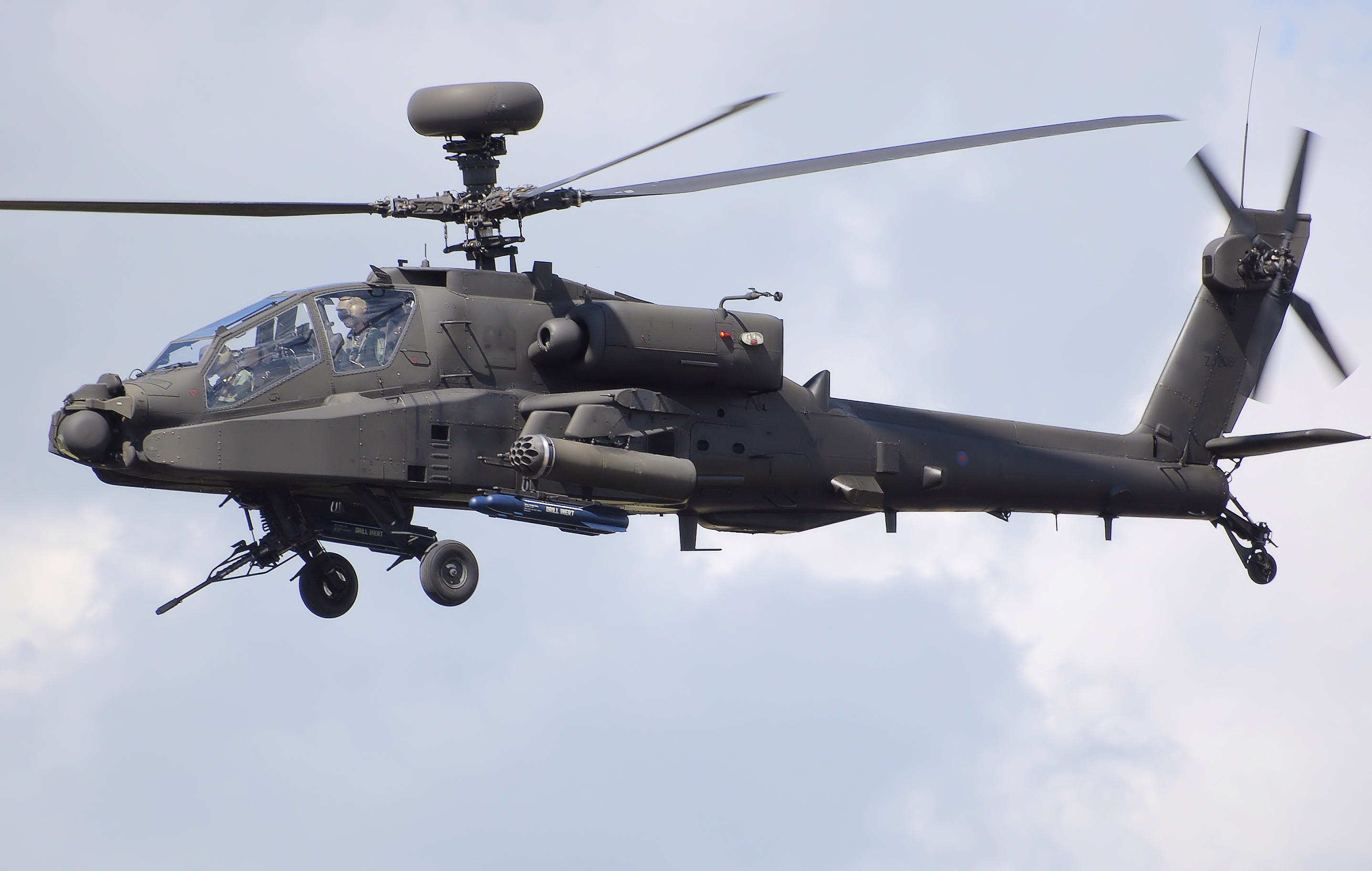
British Westland Apache WAH-64D with Longbow radar above the rotor. Photo: Adrian Pingstone, public domain.

AN/APG-78 Longbow radar close-up. Photo: Hunini, 2013; cropped by Marc Lacoste in 2020. CC BY-SA 3.0.
Here is why that trailer scene amazed me in 1996: the sensor sits above the rotor. In suitable terrain, much of the helicopter can stay under cover. For more details, see the AN/APG-78 Longbow article on Wikipedia. These are real-aircraft photographs, not game screenshots.
More than a flying crosshair
Longbow is interested in far more than a joystick. The AH-64A and AH-64D variants, radar, targeting, electro-optical systems, weapon selection, cockpit instruments, flight dynamics, threats, wingmen and mission planning all contribute to its appeal. The training sequences treat these systems as subjects to understand, not obstacles to skip. Realism and difficulty options let players adjust the experience without removing its complex core. [2][3][4]
The graphics make sense only in their historical setting. Polygon landscapes, draw distances, terrain detail levels, cockpit displays and video sequences on DOS hardware all involved compromises between memory, processor time and frame rate. They are not photorealistic by modern standards. But they created a usable, convincing technical world on PCs whose limitations are easy to forget today.
Origin was not just making a fast action backdrop. Missions were meant to feel like chains of decisions: where should I fly? What can I see? What can see me? Which system do I need? When do I hide? That is exactly why I could spend hours with the manual without ever taking off.
Thirty years later: my real Windows 98 retro PC
I could have tried to emulate the game on modern hardware. But there was that box in front of me – with its actual CDs. I wanted a real optical drive and a real CRT monitor. Fortunately, my retro machine was ready. Or so I thought.
| Component | My test system on 3 November 2026 |
|---|---|
| Processor | Intel Pentium III, 500 MHz |
| Memory | 128 MB RAM |
| Operating system | Windows 98 Second Edition |
| Graphics | S3 Trio64V+ (PCI); an internal ATI 3D Rage Pro is also available |
| Sound | Aztech AZT2320 (ISA), Sound Blaster Pro compatible |
| Hard disk | Quantum Fireball lct15, 15 GB (around 13.9 GB shown in Windows) |
| Optical drive | Plextor UltraPleX PX-40TS, SCSI, 40× |
| Controller | Adaptec AHA-2940UW PCI SCSI |
| Display | Real CRT monitor |
That Pentium III has plenty of headroom for the original Longbow. The game was developed for much slower mid-1990s PCs and could still push powerful contemporary systems. This is not a benchmark of 1996 frame rates; it is a reunion on suitably old, if somewhat later, hardware.
Twenty-five drives, no IDE cable – and a return to SCSI
The plan was straightforward: insert original CD, install, fly. Except there was no optical drive connected. Power off, case open, expedition to the attic. There are roughly 25 CD drives, DVD drives and burners up there. Surely this would take two minutes.
There were plenty of drives. But not one IDE cable.
Plan B: remove the old network adapter, a wonderful relic with BNC coaxial Ethernet, RJ45 and a “Yes NetWare Tested and Approved” sticker, and bring back the Adaptec AHA-2940UW. The S3 Trio64V+ and ISA Aztech stayed in place. The Aztech sounds so good in Duke Nukem 3D that sacrificing it was out of the question.
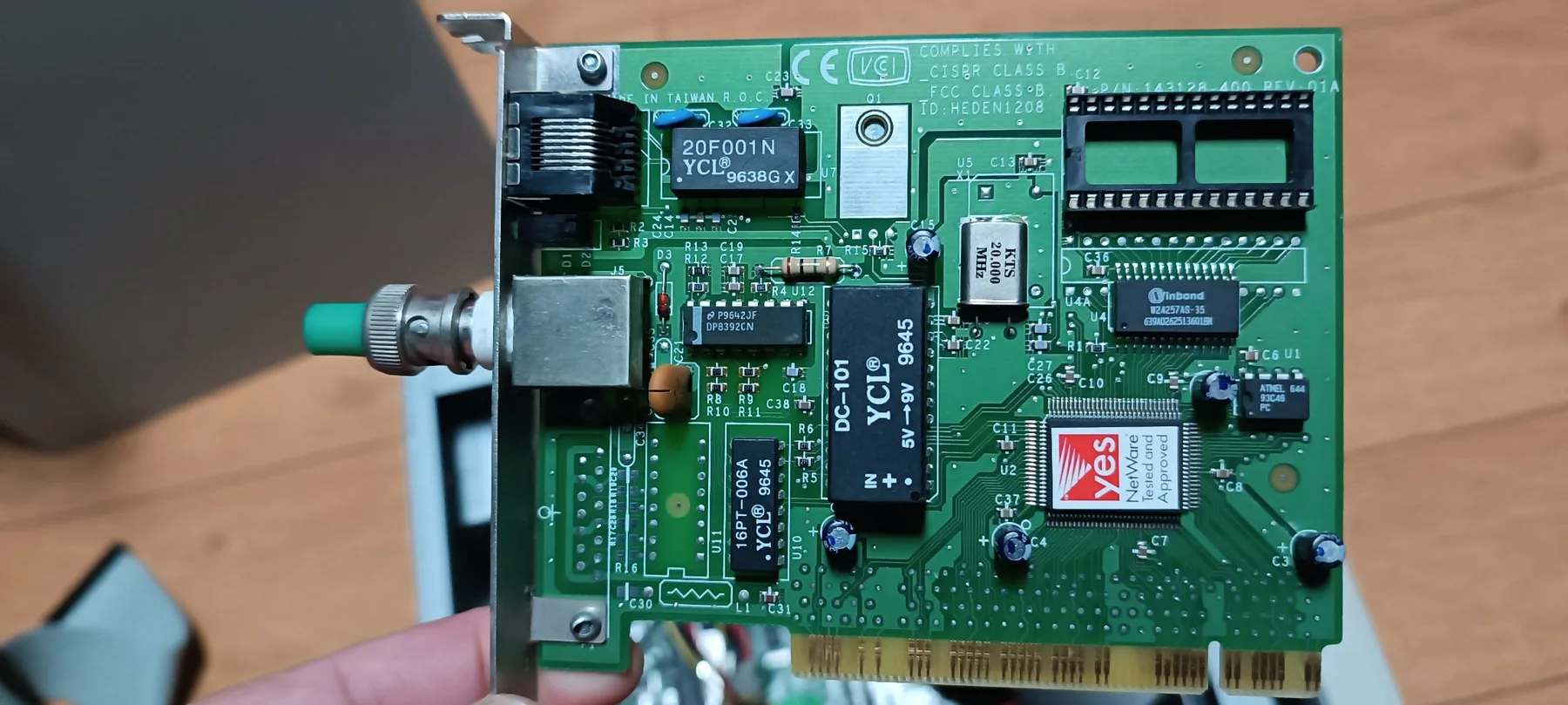
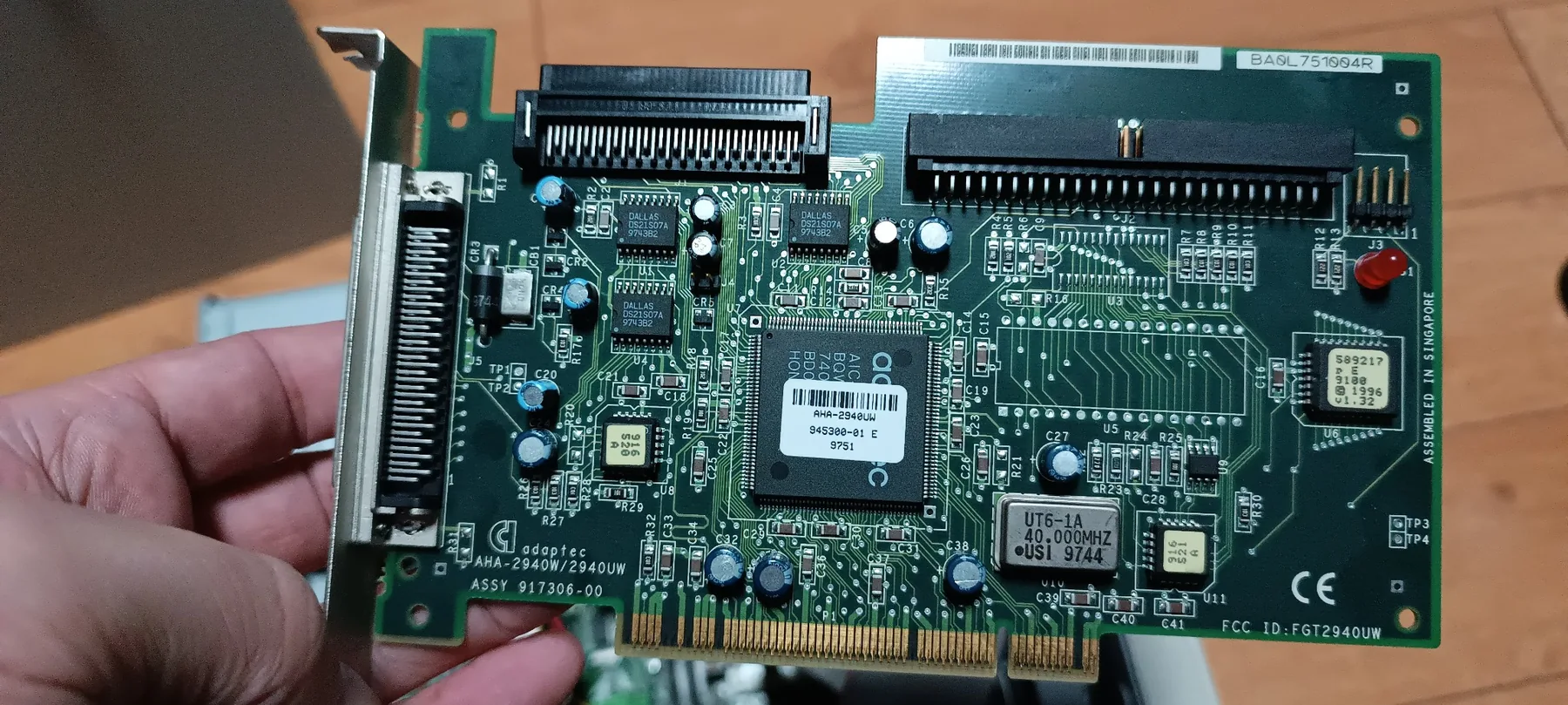
With the Plextor PX-40TS and Quantum Fireball lct15, an entire generation of hardware found itself working together again. The upper Yamaha 4×4×16 SCSI CD burner was initially connected as well. I did not yet know how important that detail would become.
Then there was the case. My modern Corsair 4000D stood nearby, probably laughing at the whole operation. Its panels come off with almost insulting ease. I was wrestling with an old steel PC case like somebody trying to close an overstuffed holiday suitcase. When it finally shut, my back cracked.
The old hardware was still going strong. The 41-year-old pilot was showing the first signs of wear.
Plug and Pray: a blue screen in the Adaptec driver
In the open-case test, Windows had seen the SCSI drive. After closing the case, things got interesting: Windows found a driver, the mouse froze, the machine rebooted without warning and then requested a driver all over again. When I selected a different Adaptec entry in Device Manager, I was rewarded with a sight I had not seen for years:
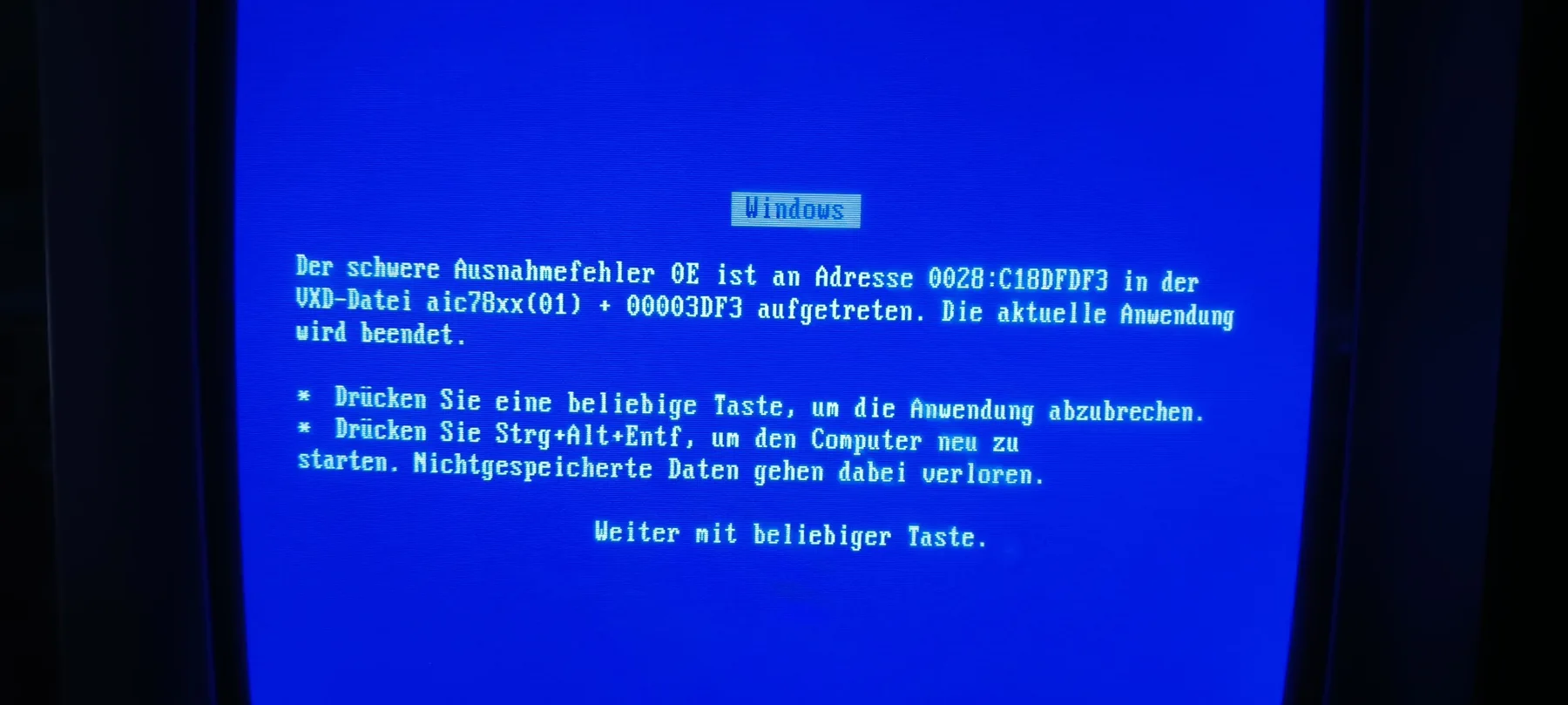
aic78xx driver. German-language error screen. © Dennis Hilk · 2026A genuine Windows 98 blue screen on a genuine CRT. Exception 0E in aic78xx(01). That belongs to the Adaptec driver family – an important clue, though not proof of any particular hardware fault.
Then something clicked: the Adaptec SCSI BIOS, which had appeared earlier, no longer showed up during boot. Something had changed before Windows even started. A quick experiment brought it back: disconnect the Yamaha SCSI burner, and the Adaptec BIOS appeared again; the Plextor was detected. Windows could once more open and eject the drive.
Was the culprit the Yamaha itself, a duplicate SCSI ID, termination or cabling? I did not determine that conclusively on the day. So this remains an observed correlation, not an invented diagnosis. The practical result was enough: with just the Plextor connected, the mission continued.
This is retrocomputing. I wanted to install a flight simulator and first had to establish a ground crew for my PC.
36, 68 or 97 MB: give me maximum terrain detail
At last, installation began. The green Jane’s setup screens – Apache silhouettes, dramatic photography and carefully composed menus – felt like a little event in themselves. On a CRT, this does not look like an anonymous installation wizard. It looks like preparing for a mission.
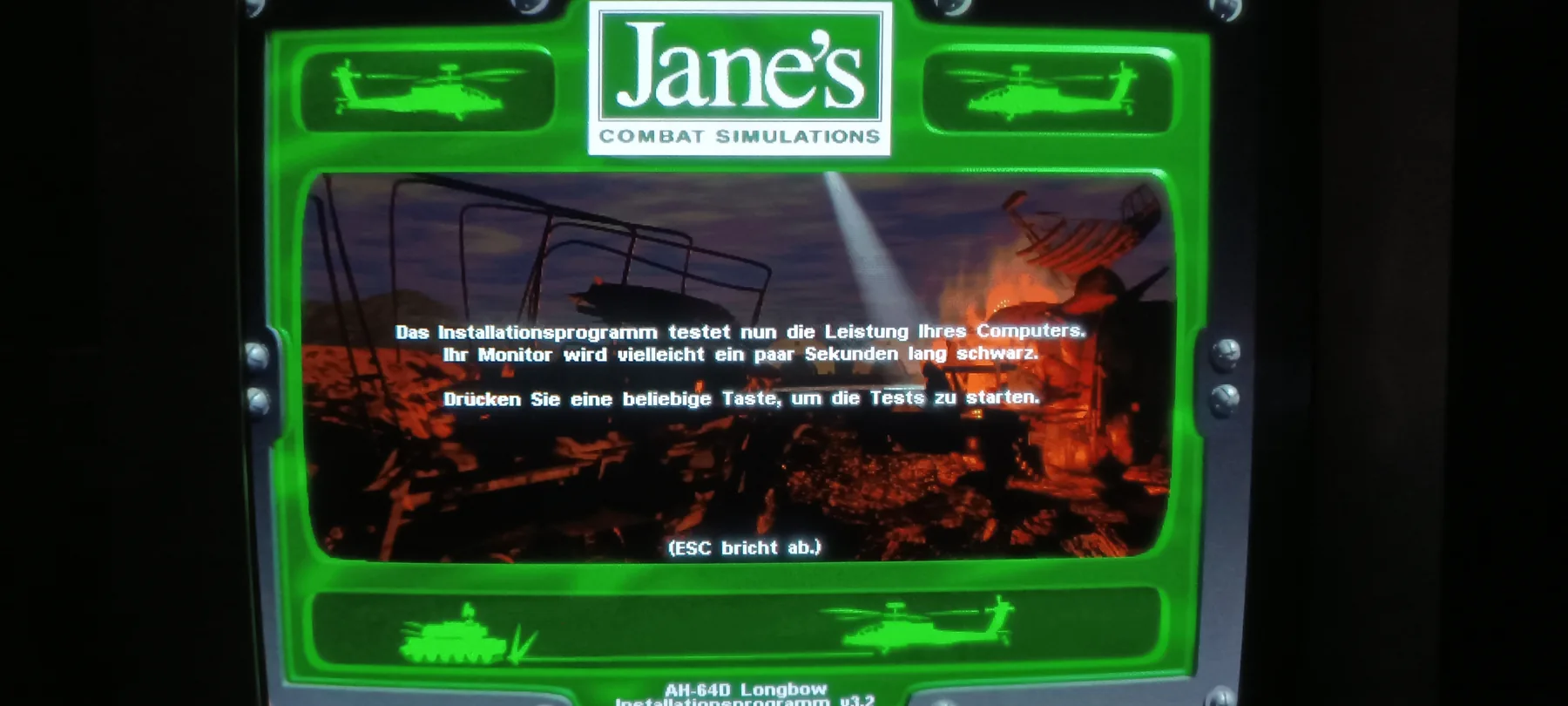
And then the installer asked how much terrain I wanted:
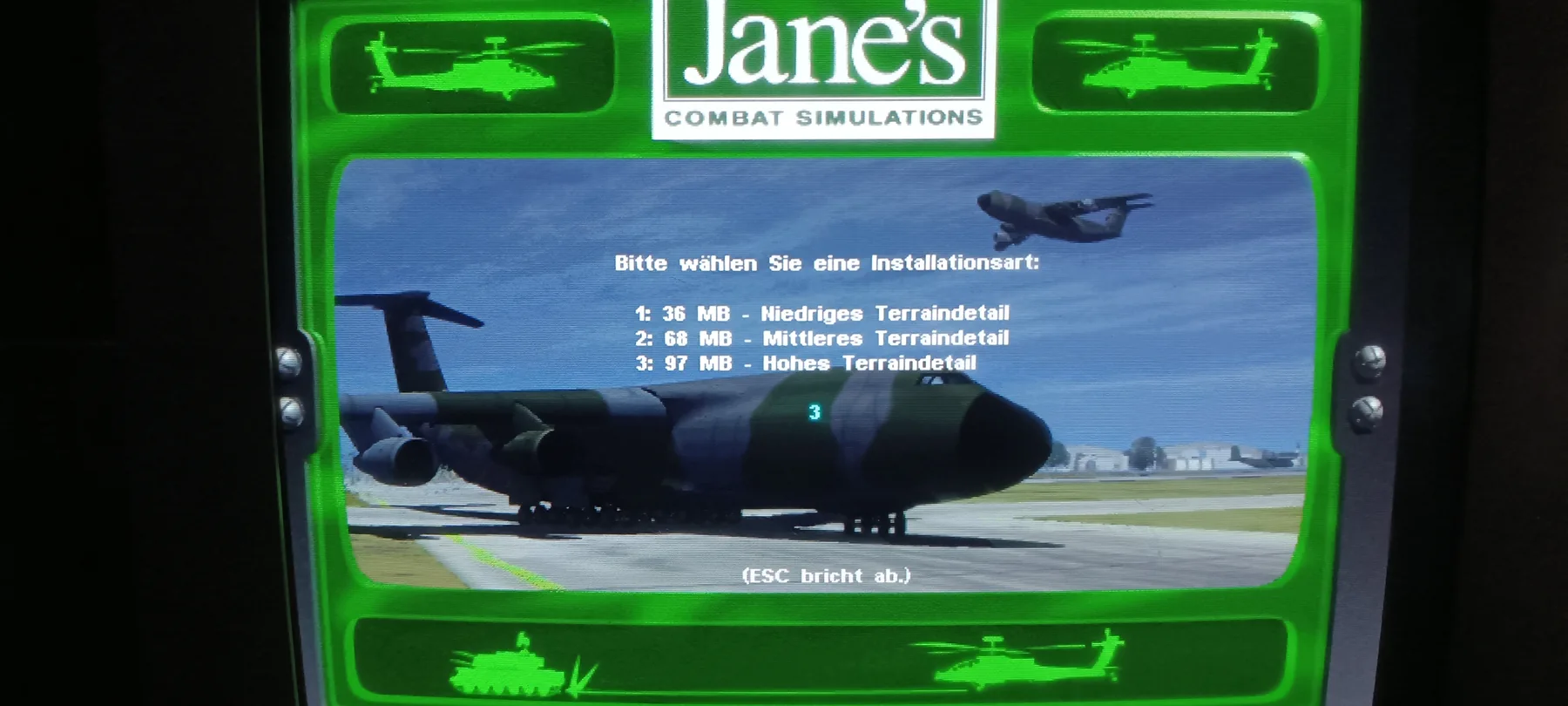
I burst out laughing. Only days earlier, I had downloaded several gigabytes of extra graphics data for War Thunder on my modern gaming PC, Cthulhu, just to make models look nicer. Now a game from 1996 was politely asking whether I could spare 97 megabytes for the highest terrain setting.
Those figures describe the installation options on my screen, not the total data on both original CDs. The discs contained more than the files the installer copied to the hard disk. Even so, the contrast across thirty years is extraordinary.
As the files went past, I spotted names like forest.mdf and desert.mdf, along with a whole mountain of GIF files. The precise contents of the proprietary .mdf files would need investigation rather than guesswork. Watching those filenames was a flashback all by itself. After all the hardware work, the actual installation seemed almost comically quick.
FILES=45, BUFFERS=45 – and “Waidmannsheil!”
The first launch was not quite a victory. The sound setup reported Digital sound hardware not found. Longbow was not impressed by my Aztech. Its configuration screens used the Miles sound system, listing Sound Blaster Pro, Sound Blaster 16, Roland hardware and other period choices. This used to be normal: you needed to know your card, address, interrupt and DMA channel.
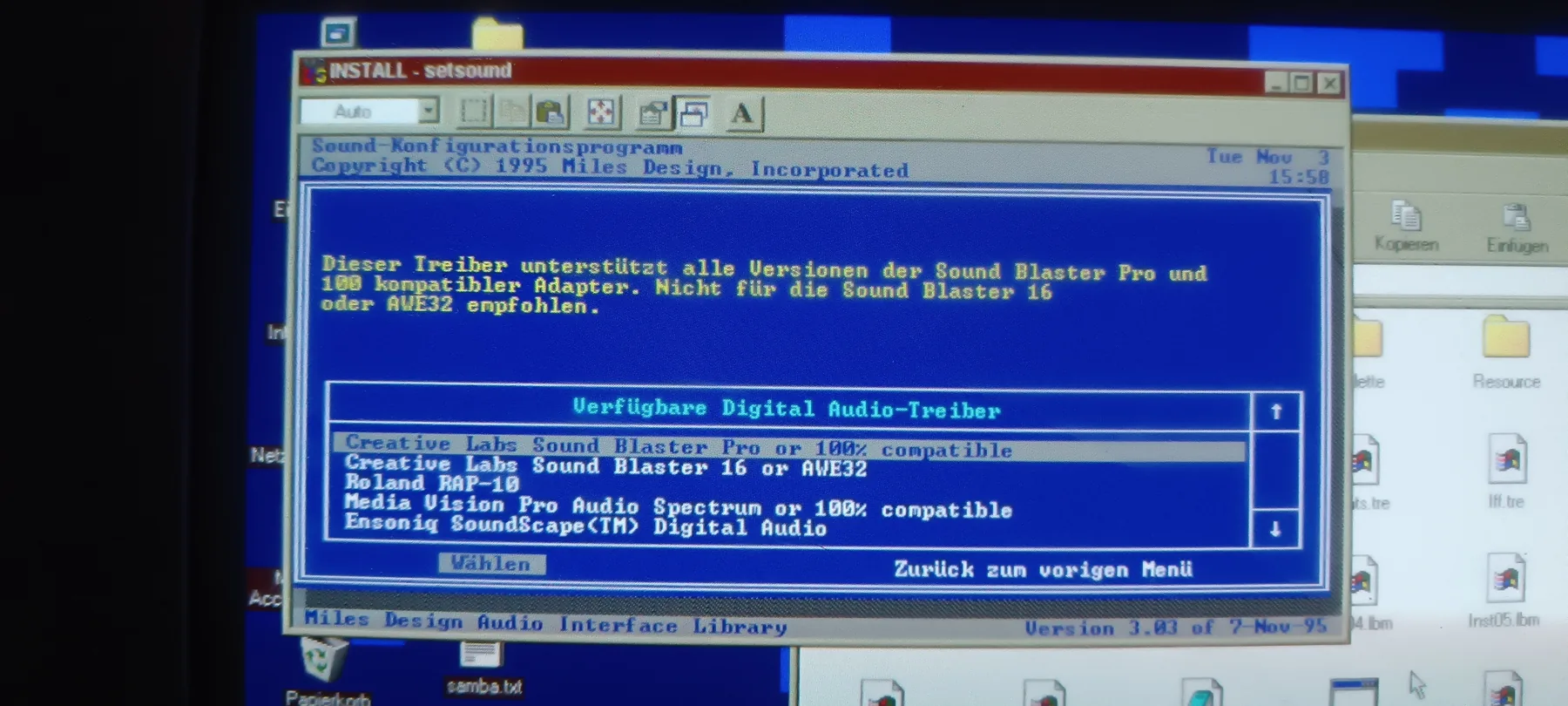
In the meantime, the game delivered another glorious error. It had found the VESA 1.2 driver, identified Windows 4.10, located its original disc – and had a complaint about the DOS configuration:
ERROR: Not enough FILES and BUFFERS.
Increase to FILES=45 and BUFFERS=45
in CONFIG.SYS. - F(33)
Waidmannsheil!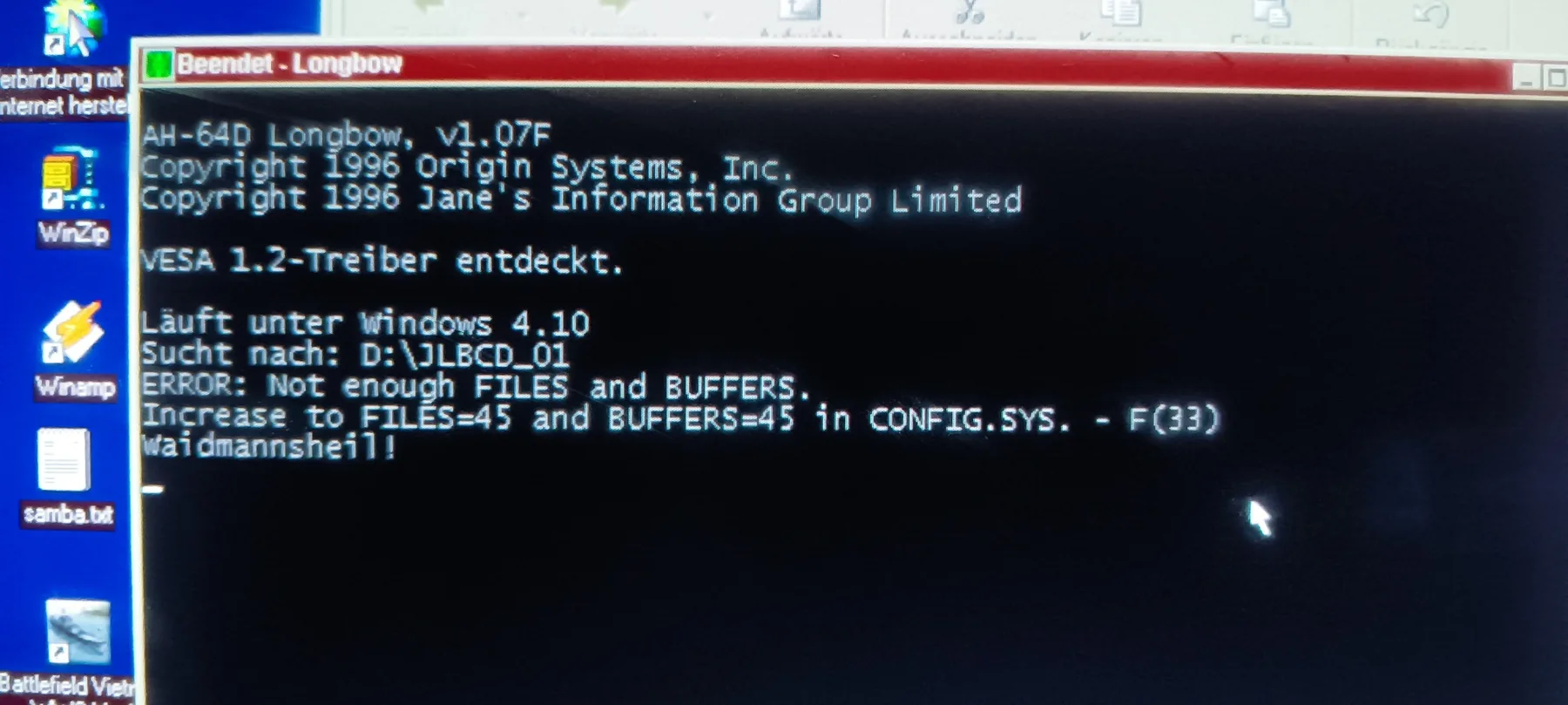
FILES=45, BUFFERS=45 – followed by a cheerful “Waidmannsheil!” © Dennis Hilk · 2026Waidmannsheil! Literally a traditional German hunting greeting, and an absolutely wonderful way to end an error message. I was laughing in front of the screen. Two lines in CONFIG.SYS supplied exactly what the game demanded:
FILES=45
BUFFERS=45
And sure enough: Longbow now launched under Windows 98 SE. That was the big success of the day. No modern community patch, just two old-school DOS configuration lines.
The Apache runs. The Aztech is still silent
Sound was a separate adventure. I temporarily removed the Aztech to try onboard audio, searched for drivers, restarted Windows repeatedly and eventually put the Aztech back where it belonged. My PCI slots were already occupied by S3 graphics and SCSI, while the attic contained more sound cards among Mellanox 40-gigabit network adapters and an old Hauppauge WinTV card.
Eventually Windows audio returned. ICQ made its familiar “Uh-oh!” sound – and of course Winamp played “Blue (Da Ba Dee)” by Eiffel 65 as my test track. I was testing an Apache gunship's sound system with an instant messenger and the most gloriously nineties Winamp song imaginable. 😂
My present-day Linux reflexes did not help. First I typed cmd, then ls. Windows 98 reminded me that this was an MS-DOS Prompt and the directory command was dir. Running SET showed BLASTER=A220 I5 D1 T4 P330, familiar Sound Blaster Pro-style settings. But an environment variable does not, by itself, initialise an ISA Plug and Play sound card in real DOS.
Trying DOS instead of the Windows desktop did not fix it: Longbow still could not find working digital sound hardware. At that point the hard disk had only the Windows driver installed, not a separately configured DOS initialisation utility for the AZT2320. That is a plausible lead, not a demonstrated fix.
Original CDs read · Installation successful · Longbow launches on Windows 98 SE · Windows sound works · Longbow digital audio remains unresolved. More DOS sound-card archaeology can wait until there is daylight in the attic again. 😉
Even a virtual helicopter, it turns out, needs a second maintenance shift sometimes.
When a game still came with a phone number
One of the old screens also showed the German Electronic Arts customer-service number, complete with office hours, a fax number, a British postal address and an ancient web address. A tiny fossil of an entirely different relationship between people and their software.
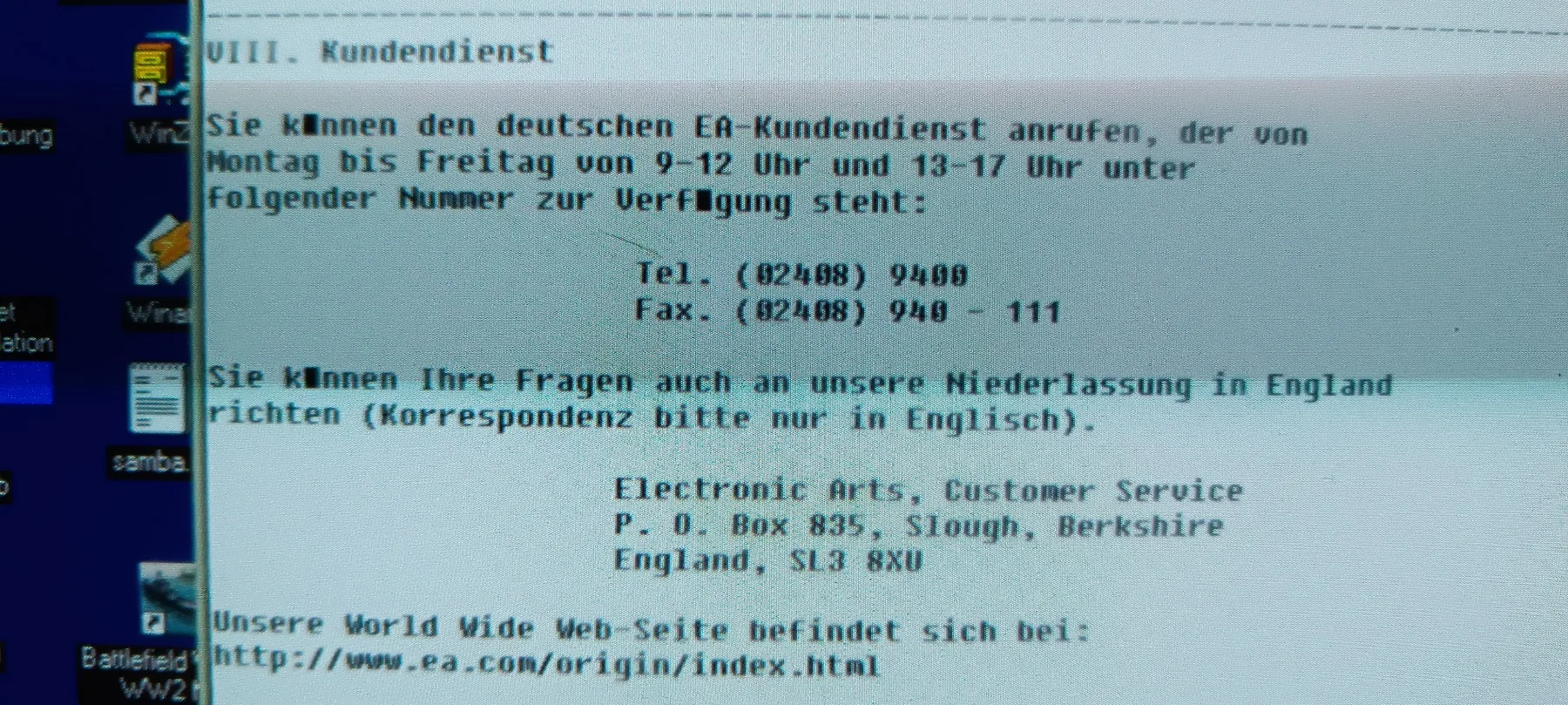
I remember having an actual problem with Monkey Island back then and calling support. A real person talked me through it, and it genuinely helped. Years later, during the original era of World of Warcraft, a Game Master even appeared beside my character in-game and helped me personally.
That is not an argument that every 1990s hotline was wonderful, or that every modern service is worse. It is simply why those particular memories stayed with me. A game came with printed information, ways to contact its publisher and, sometimes, a human being who could actually help.
Not everything was better back then. But some things really were.
As I sat on the floor with the binder and later returned to debugging DOS errors, I kept thinking about something bigger than Longbow: What do I expect when I buy a game? My answer is rather old-fashioned. I do not want to buy the possibility that a game might become good after months of patches. I want a release that is essentially finished on launch day.
Of course there were bugs, patches and disappointing releases in 1996 as well. Today's Longbow adventure has supplied ample evidence of that. And Early Access can be an honest, valuable way for smaller developers to build a game together with their players – when everyone knows they are supporting unfinished work. What bothers me is a full-price, heavily advertised release that feels like a beta test on day one. The business around games has grown: release schedules, pre-orders, ongoing services, online dependencies and the assumption that things can be fixed after launch. Sometimes the care I expect from a finished product gets lost along the way.
Battlefield 2042 received substantial criticism for its rough 2021 launch. [7] Microsoft Flight Simulator 2024 offers an especially relevant comparison: when it launched on 19 November 2024, overloaded online services caused long loading times and missing content. The development team publicly acknowledged the problems and apologised. Even a technically ambitious flight simulator can end up grounded by its infrastructure. [6]
For the WoW Forever start I am expecting on 5 November 2026, I anticipate heavy demand and would rather take a relaxed look over the weekend. That is my expectation, not a claim that any server failure has already happened. Experiences like these have given me one personal rule: I no longer pre-order games.
There is a reason that thought keeps coming up while revisiting Longbow. Origin Systems, the developer behind the game, was acquired by Electronic Arts in 1992. After the success of Ultima Online, Origin was directed increasingly towards online games; several projects were cancelled. Richard Garriott left in 2000, and the studio closed in 2004. When EA reused the name Origin for its digital distribution client in 2011, the same word had come to mean something very different. That does not make every developer in the past better, nor does it make EA solely responsible for an industry's evolution. But when you are holding a thirty-year-old Origin manual, the contrast is hard to miss. [8][9]
What I often miss, too, is human contact. Back then someone genuinely helped me over the phone with Monkey Island; later, a World of Warcraft Game Master even appeared beside my character in the game. These days support can mean an overloaded ticket system or a bot asking for the third time, “Have you tried turning it off and on again?” That is not a verdict on every modern support team, nor on every AI assistant. It explains why one helpful conversation from decades ago can still mean something.
My Monkey Island thought experiment sums it up: imagine a major adventure launching as a barely playable full-price product, while customers were told to wait months for basic repairs. Period magazines and forums would hardly have been delighted either. I do not miss every cable tangle and endless reboot. I miss the care you can feel in a finished game and in the way its customers are treated.
A Y2K detour: “More trial days for me!”
Digging through the hardware also brought back another period detail: a Year 2000 bug sticker. In late 1999, Y2K was everywhere. People asked if I had heard the news and whether I was worried about what would happen when the date changed.
My teenage response was fairly relaxed: “You can play cards if you like; I’m not running an oil platform here. Worst case, my PC thinks it’s 1900 again. Maybe that means more trial days for some shareware demos!”
I really did have programs where I had moved the Windows calendar back to keep using a trial, only for the software to greet me cheerfully again. I still associate a friendly “Have a great time” with that peculiar period of computing.
For the record, the Y2K bug was a genuine engineering problem. Two-digit year fields could break date calculations in business software, financial systems and embedded controllers. For critical infrastructure, it deserved serious attention. My joke was the perspective of a kid using his own home PC, poking fun at blanket panic rather than the real need for preparation. [5]
Why this box still makes me happy thirty years later
Today I rediscovered what computing felt like when I was young – not only when it worked, but during the searching, opening, swapping, installing, rebooting and figuring things out. The steel case fought me like a suitcase, my back cracked, Windows produced a genuine blue screen and a game wished me Waidmannsheil.
And in the middle of it all lay that almost untouched ring binder. The German edition my parents had given me for my birthday. The memory of Florida. The fascination with a helicopter that could hide behind a hill while its radar looked over the top. The joy of wanting to understand something so badly that an instruction manual became a world of its own.
Jane’s AH-64D Longbow runs again. The audio will get another attempt. But the feeling of opening that box? That came back in full today.
Perhaps the best thing I can say about retrocomputing on this particular Tuesday is:
I’m not simply playing games from the nineties. I’m living the entire experience again. ❤️🚁
Sources and scope
- MobyGames – original release, developer, credits and platform.
- GameSpot – period assessment of its flight model, missions and hardware demands.
- Ars Technica – a history of flight simulators.
- Release history: Longbow, Flash Point Korea, Gold and Longbow 2.
- Library of Congress – historical background on Y2K.
- Microsoft Flight Simulator – official 20 November 2024 launch-day statement.
- Ars Technica – Battlefield 2042 launch review.
- MobyGames – Origin Systems, acquisition, Garriott’s departure and studio closure.
- Electronic Arts – official Origin digital platform launch, 3 June 2011.
- Wikipedia – the AN/APG-78 Longbow radar.
- Wikimedia Commons – Apache helicopter photograph by Adrian Pingstone (public domain).
- Wikimedia Commons – Longbow radar photograph by Hunini, crop by Marc Lacoste (CC BY-SA 3.0).
All hardware and installation photographs in this article show my own retro PC and my reacquired German big-box edition on 3 November 2026. Hardware findings and error messages concern this specific test; childhood memories are identified as such.