In this article
Quick summary: what you need to know
On 18 November 2026, nginx released 1.30.7 (stable) and 1.31.9 (mainline), addressing ten security issues. HTTP/2 memory corruption is particularly serious, while other flaws require HTTP/3, TLS 1.3, mail proxy, DNS resolver or stream-specific configurations. Whether a system is exploitable depends on its distribution patch level and enabled features.
All terminal images in this article are real captures from my Debian 13 server on 19 November 2026. They have only been cropped and given headings; visible responses are unaltered. Private admin routes and internal backend addresses are excluded.
As of the morning of 19 November 2026: Debian's Security Tracker still marked the Trixie security package 1.26.3-3+deb13u10 as vulnerable to several new November CVEs. That revision fixed older issues in October; it did not automatically include the newly announced November fixes. Always check the tracker again.
I documented a real Debian 13 production-host check on Worldnode: package version, nginx configuration, PHP detection, HTTP/2 and HTTP/3, TLS 1.3 and TLS 1.2. These are reproducible checks – not a penetration test or a claim of complete security.
November 2026 nginx vulnerabilities: which features matter?
Ten CVEs does not mean ten exploitable paths on every server. Some require HTTP/2, others HTTP/3 with upstream forwarding, mail authentication, TLS 1.3, or specific alias/variable combinations. The relevant question is not just whether nginx is installed but which exposed functionality actually exists.
| CVE | Component | Relevant precondition |
|---|---|---|
| CVE-2026-123007 | HTTP/2 flow control | HTTP/2 flow control memory corruption |
| CVE-2026-123633 | HTTP/2 use-after-free | HTTP/2 with upstream forwarding |
| CVE-2026-121810 | HTTP/3 use-after-free | HTTP/3 with upstream forwarding |
| CVE-2026-123634 | Resolver use-after-free | variable upstreams and SSI/mirror |
| CVE-2026-118899 | TLS 1.3 request body | TLS 1.3 with HTTPS |
| CVE-2026-113425 | Mail proxy use-after-free | mail proxy using auth_http |
| CVE-2026-125283 | alias + try_files | alias, map variable and regex captures |
| CVE-2026-120967 | stream client certificate/SNI | stream client certificate validation |
| CVE-2026-123640 | stream ssl_preread | stream ssl_preread module |
| CVE-2026-120993 | stream PROXY protocol v2 | only some newer 1.31 builds; 1.26.3 not affected |
Version caveat: According to nginx and Debian, CVE-2026-120993 affects certain 1.31.x releases, not the older 1.26.3 branch. This table maps functionality; it does not label every Debian 13 installation exploitable against every CVE.
Debian 13 and nginx 1.26.3: why the full package revision matters
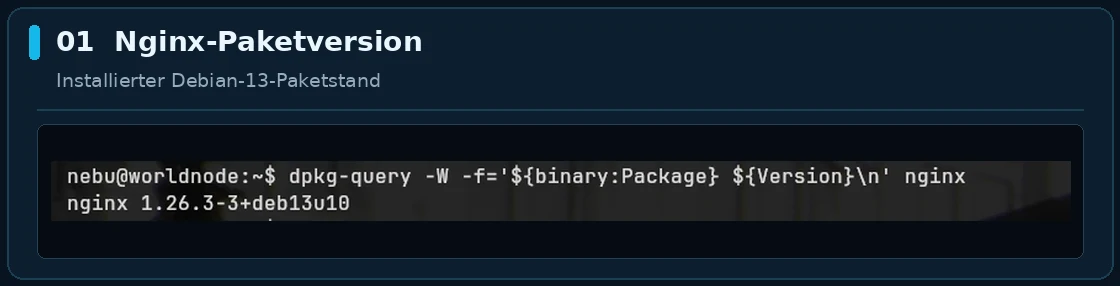
Debian commonly backports fixes to stable package versions. Do not decide solely from the upstream number shown by nginx -v. Look at the complete Debian revision and the distribution's CVE tracker. On the morning of 19 November, this host had 1.26.3-3+deb13u10 installed, with the same package still offered as the APT candidate.
dpkg-query -W -f='${binary:Package} ${Version}\n' nginx
apt-cache policy nginx
apt list --upgradable
All three commands are read-only. If needed, sudo apt update refreshes the package lists without installing upgrades.
Copy-and-paste nginx security checks on Debian 13
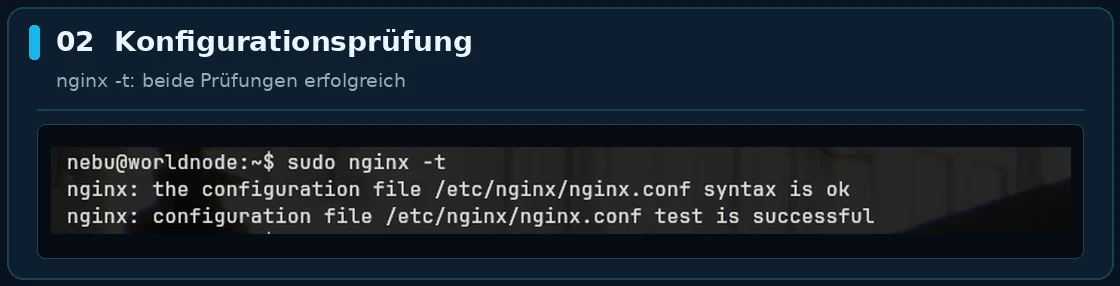
1. Validate the nginx configuration
sudo nginx -tsyntax is ok and test is successful indicate valid configuration, not that all vulnerabilities are fixed.
2. Check for HTTP/2 listeners
sudo nginx -T 2>/dev/null | grep -nE '^[[:space:]]*(listen[[:space:]][^;]*http2|http2[[:space:]]+on;)' || echo 'No HTTP/2 directive found'No matching HTTP/2 activation was found in the tested configuration. This reduces exposure to HTTP/2-specific issues but says nothing about other services or upstream proxies.
3. Check HTTP/3 and QUIC
sudo nginx -T 2>/dev/null | grep -nE '^[[:space:]]*(listen[[:space:]][^;]*quic|http3[[:space:]]+on;)' || echo 'No HTTP/3/QUIC directive found'4. Interpret PHP package status correctly
dpkg-query -W -f='${db:Status-Abbrev} ${binary:Package} ${Version}\n' 'php*' 2>/dev/null || trueIn dpkg, ii means installed, whereas un means not installed. An unversioned package name is not proof of a functioning PHP runtime. The tested Debian package inventory contained no installed PHP runtime, but containers or manually installed runtimes require separate checks.
5. Inspect HTTPS and TLS protocols
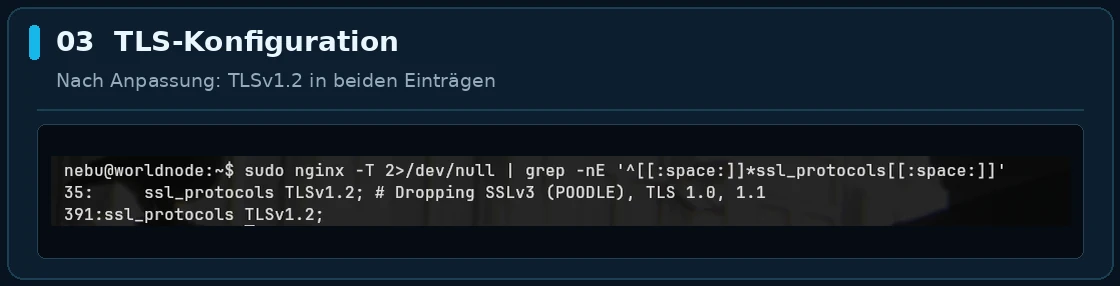
sudo nginx -T 2>/dev/null | grep -nE '^[[:space:]]*(listen|ssl_protocols)[[:space:]]'The tested HTTPS configuration enabled TLS 1.3. CVE-2026-118899 can make an nginx worker loop indefinitely while reading a request body over a specially crafted TLS 1.3 connection. An ordinary successful HTTPS response does not rule out the flaw.
6. Inspect unattended security update logs
sudo tail -n 35 /var/log/unattended-upgrades/unattended-upgrades.logAutomatic security updates are enabled through unattended-upgrades on my Debian 13 server. I regularly review update activity and logs.
Logs show when the job ran; the allowed repositories and actual package installs must be checked separately. Automated updates cannot supply a patch that Debian has not published yet.
Mitigation while Debian security packages are pending
A corrected distribution package is the preferred fix. Until one is available, a targeted temporary mitigation may reduce exposure to a specific feature:
- HTTP/2: disable exposed HTTP/2 listeners if not needed. CERT-EU recommends this interim mitigation for CVE-2026-123007 and CVE-2026-123633.
- HTTP/3: disable QUIC/HTTP/3 if affected and not required.
- TLS 1.3: temporarily remove TLS 1.3 from the effective
ssl_protocolssettings to mitigate CVE-2026-118899, while retaining TLS 1.2. This is not a recommendation to disable modern TLS permanently. - Other features: evaluate mail proxy, resolver and variable upstreams, SSI/mirror,
alias/try_files, and stream modules individually.
Avoid blind search and replace on production: a host may have global and per-vhost protocol settings, shared includes and Certbot-managed files. Back up first, make a targeted change, run nginx -t, reload nginx and test each HTTPS service. Certbot updates may overwrite some settings, so recheck after future renewals or changes.
sudo nginx -t
sudo systemctl reload nginx
Observed verification: after the temporary adjustment, a TLS-1.3-only handshake failed (HTTP 000), while a TLS-1.2-only request returned HTTP 200. The same positive and negative tests were repeated on a second HTTPS service. No exploit payload was sent.
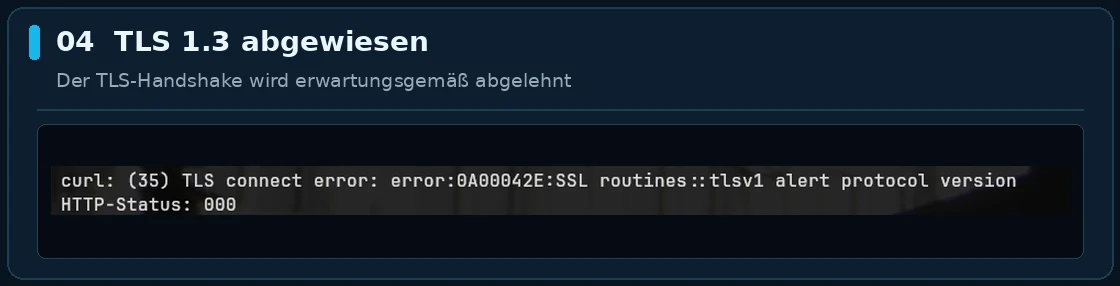
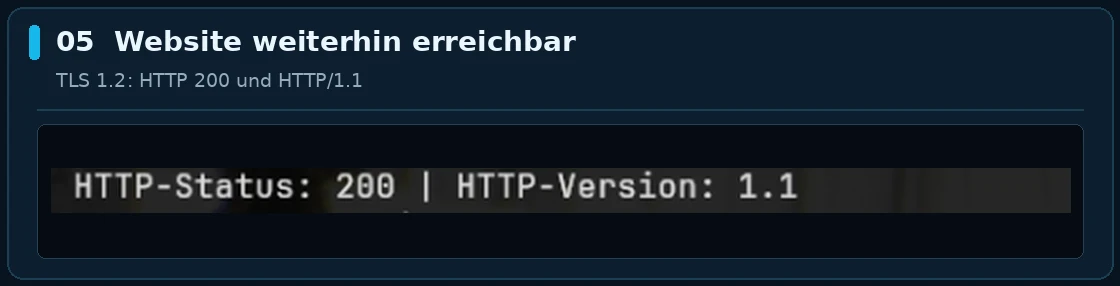
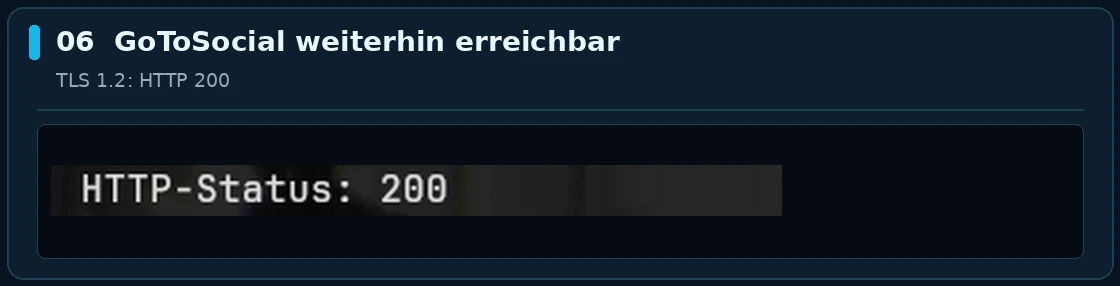
Only safe terminal excerpts are included here. The public article deliberately omits admin routes, local backend ports, internal mappings and complete virtual-host configuration.
What about the PHP security updates on 19 November?
Additional PHP security releases were scheduled for 19 November. Check the actual release versions at publication time. nginx and PHP are separate components; running nginx does not imply an installed PHP runtime. WordPress and other PHP users should verify PHP-FPM, package origins and application dependencies separately. Even a URL ending in .php can serve static HTML without executing PHP.
FAQ: nginx CVEs on Debian 13 in November 2026
Is nginx 1.26.3 automatically unpatched on Debian 13?
No. Debian backports fixes; check the full Debian revision and CVE-specific status. On the morning of 19 November the Trixie security revision was still flagged as vulnerable for several newly disclosed issues.
Does disabling HTTP/2 fix all ten vulnerabilities?
No. It addresses HTTP/2-specific attack paths but not TLS 1.3, HTTP/3, DNS resolver, mail or stream issues.
Why use TLS 1.2 temporarily?
With correct configuration, TLS 1.2 remains viable. Disabling TLS 1.3 here was a temporary mitigation for a specific nginx defect, to be reverted after the security update is installed.
Do unattended-upgrades guarantee the server is secure?
No. They can only install published packages. Review logs, repository configuration, service reloads and actual exposed features.
How can HTTP/1.1 work with TLS 1.2?
HTTP is an application protocol, while TLS provides encryption. HTTP/1.1 over TLS 1.2 is a normal combination.
Conclusion: verify the real attack surface, then patch
The test found no enabled HTTP/2 or HTTP/3 settings and no installed PHP runtime from Debian packages. The nginx configuration validated successfully. The TLS-1.3-specific attack surface was temporarily disabled and TLS 1.2 remained operational for both tested HTTPS services. This is risk reduction, not a patch or proof that every CVE is irrelevant. Install the Debian security fix as soon as it is available and restore TLS 1.3 after verification.
Related earlier post: October 2026 Debian 13 nginx security update, with original server logs.
Primary sources and verification date
- nginx Security Advisories
- nginx release announcement
- Debian nginx CVE tracker
- Debian CVE-2026-118899
- CERT-EU advisory 2026-022
- LinuxNews.de original news item
Checked: 19 November 2026, morning CET. Recheck the distribution patch status immediately before publication. All host findings are from direct screenshots, not a third-party vulnerability scan.