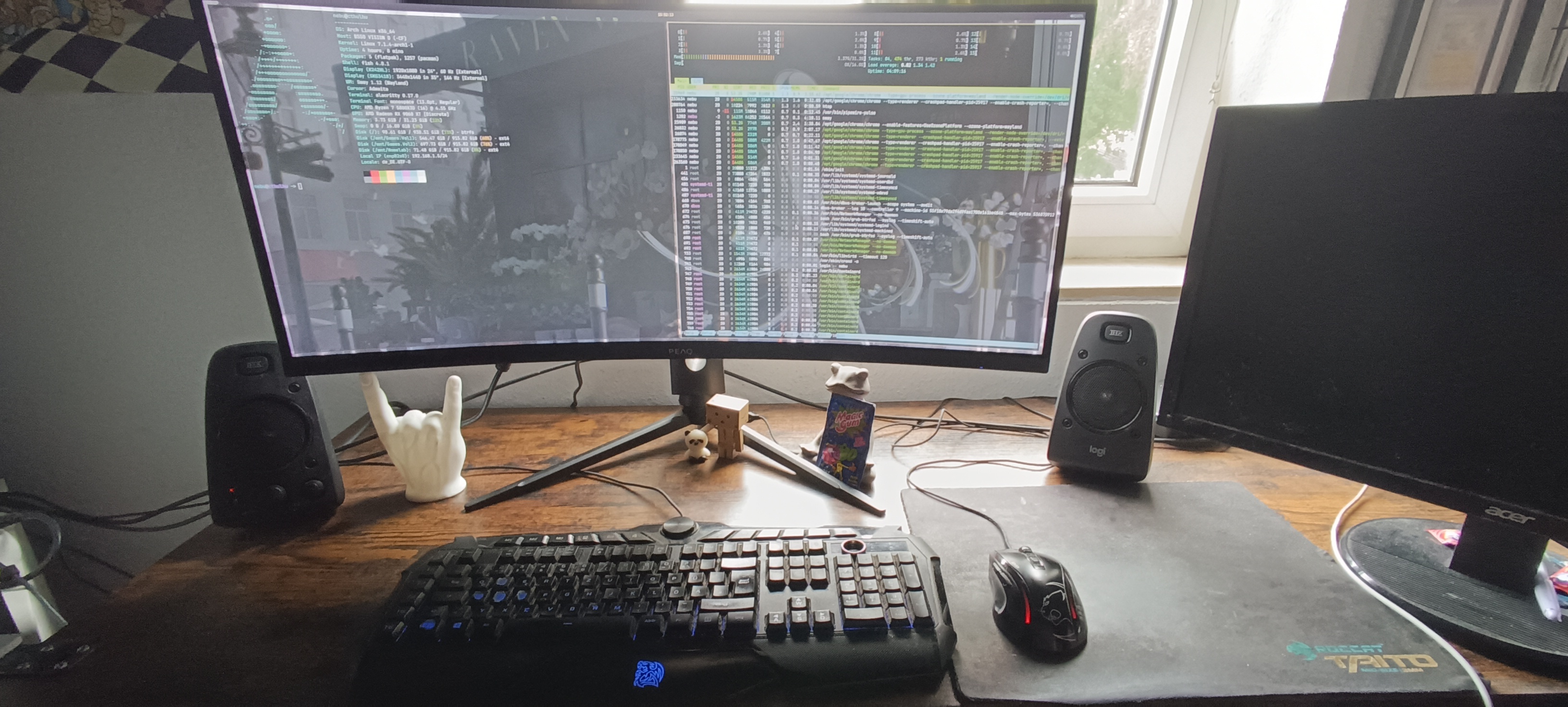
Even as a teenager, I wanted to know why some computers worked differently from the ordinary Windows PC. I read Lovecraft, wanted a Silicon Graphics workstation straight out of Jurassic Park, and kept trying operating systems almost nobody around me used. My current NixOS workstation is named Cthulhu. The name is older than almost all of its hardware.
Why I call my computer Cthulhu
The name comes directly from H. P. Lovecraft's Cthulhu Mythos. I read several of the books. At about fifteen or sixteen I had related posters on my wall: the era of MTV, Jackass, Viva La Bam and dyed hair. The theme stayed with me. By my Linux Mint days in 2013 my computer was already called Cthulhu, quite possibly earlier.
That does not mean one physical computer survived unchanged. Motherboards, GPUs and operating systems came and went. Cthulhu is a name that travels with my machines, much like nebu has remained my username. The Ryzen workstation today is simply its current incarnation.
Around 1996: Slackware, and very little understanding
My earliest Linux memory goes back to Slackware, around 1996. I found the unfamiliar system exciting, but a lot of it initially made no sense at all. Linux installation and configuration required much more manual work back then; video tutorials for every little problem were not a thing.
What mattered was that Linux was not mainstream. I wanted to know what it did differently, why everyone else did not use it and what could be possible. Many distributions were also free to obtain. Curiosity was a good enough reason to try them.
Welcome to a different kind of PC
login: nebu
$ _
A modern text-console illustration, not an original screenshot or historical log. The 1996 Slackware 3.1 archive provides period context, not proof of my exact installed version.


Asking for OS/2 Warp 4 for my birthday
At one point I actually asked for IBM OS/2 Warp 4 as a birthday present. Did I have a useful software library for it? No. Did my games run? Also no. Did I still think it was cool? Absolutely. I wanted to see a different desktop, different design decisions and a different way of using a computer.
SUSE turned up on a magazine cover CD, too. Those discs felt like portals into another computing world. You tried something simply because it was there and you were curious, not because it promised better performance in your favorite game.
Jurassic Park: SGI? I want one!
In Jurassic Park it was not just the dinosaurs that caught my eye. Those unusual Silicon Graphics workstations and the futuristic UNIX world were unlike the PCs I knew. I wanted both the hardware and that strange interface. Later I even explored the old source of the well-known SGI 3D file manager fsn.
You can still occasionally find old SGI machines on eBay. Then you see the price, shipping from the US, import costs and the chance that the delivery service will turn a vintage workstation into an expensive puzzle. My Jurassic Park poster, meanwhile, is still on the wall.
%20with%20large%20CRT%20monitor%20displaying%20a%20window%20of%20IRIX%20operating%20system.jpg?width=960)
_with_large_CRT_monitor_displaying_a_window_of_IRIX_operating_system.jpg)
Knoppix, cover CDs and systems you could simply try
Knoppix was especially fun for showing other people Linux: booting an entire working system from a CD without replacing Windows on their drive. It felt almost like a magic trick. I liked Ubuntu in its earlier days as well, although it is not my favorite today. I still appreciate Debian, Arch and Gentoo for different reasons.


2013: Linux Mint, Windows and LAN nights
By 2013 my Linux Mint computer was already called Cthulhu. I think it may have used an AMD Athlon 64 X2, but I cannot confirm the exact model now. Windows remained available through dual-boot. Whenever friends came over for LAN gaming, I was the only Linux user. Counter-Strike, DOOM, Command & Conquer, Battlefield, Diablo and World of Warcraft were often simpler to run under Windows.
That never made me like Linux any less. Dual-boot was a practical choice. When people came over, I wanted to play; on other days, I wanted to discover what my other operating system could do.


It was never a single switch to Linux
It would be misleading to claim I installed Mint once in 2013 and never looked back. I went through phases of using only Debian, only Mint and only Arch, along with other dual-boot stages. The permanent departure from Windows came later: since the Gentoo / XMonad installation documented in my museum, I have had neither Windows nor dual-boot on my main daily machine.
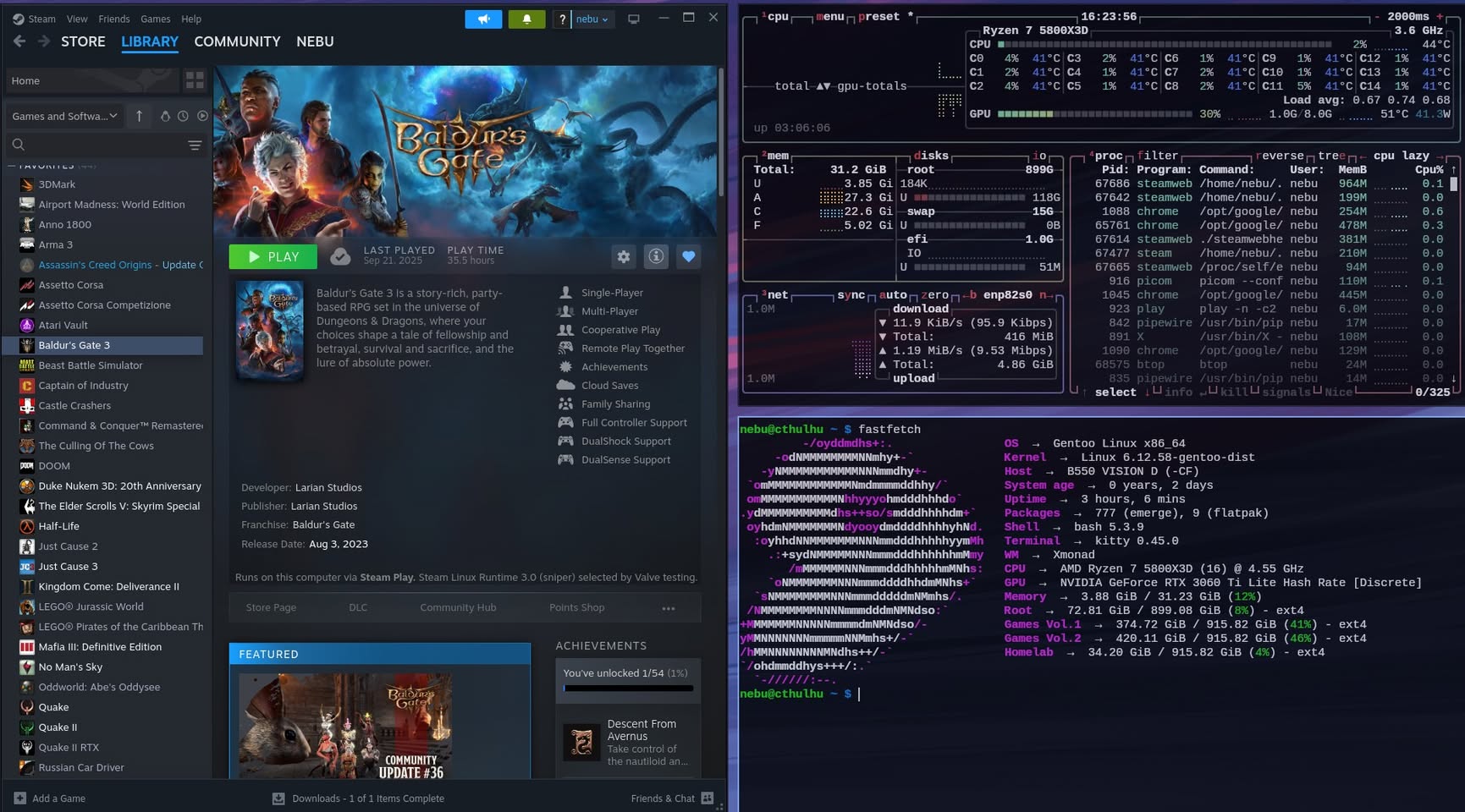
I even preserved the Corsair MP600 with its last working Gentoo/XMonad installation. When I tested it again a few months ago, it still booted. The earlier Samsung 970 EVO preserves a Windows 10 / Debian dual-boot stage. These old drives have become part of my computing history.
From a dual-core PC to a Ryzen workstation
The early AMD period is an approximate memory, not a complete parts register. A later Cthulhu configuration had an Intel Core i7-7700K and MSI GeForce GTX 970 Gaming 4G. After that I moved to the Ryzen 7 5800X3D and Gigabyte B550 Vision D. DDR5 was not compelling enough for a new platform at the time; the Ryzen's 3D cache was attractive for WoW Classic. A white RTX 3060 Ti followed, and later the Radeon RX 9060 XT Hellhound Spectral White.
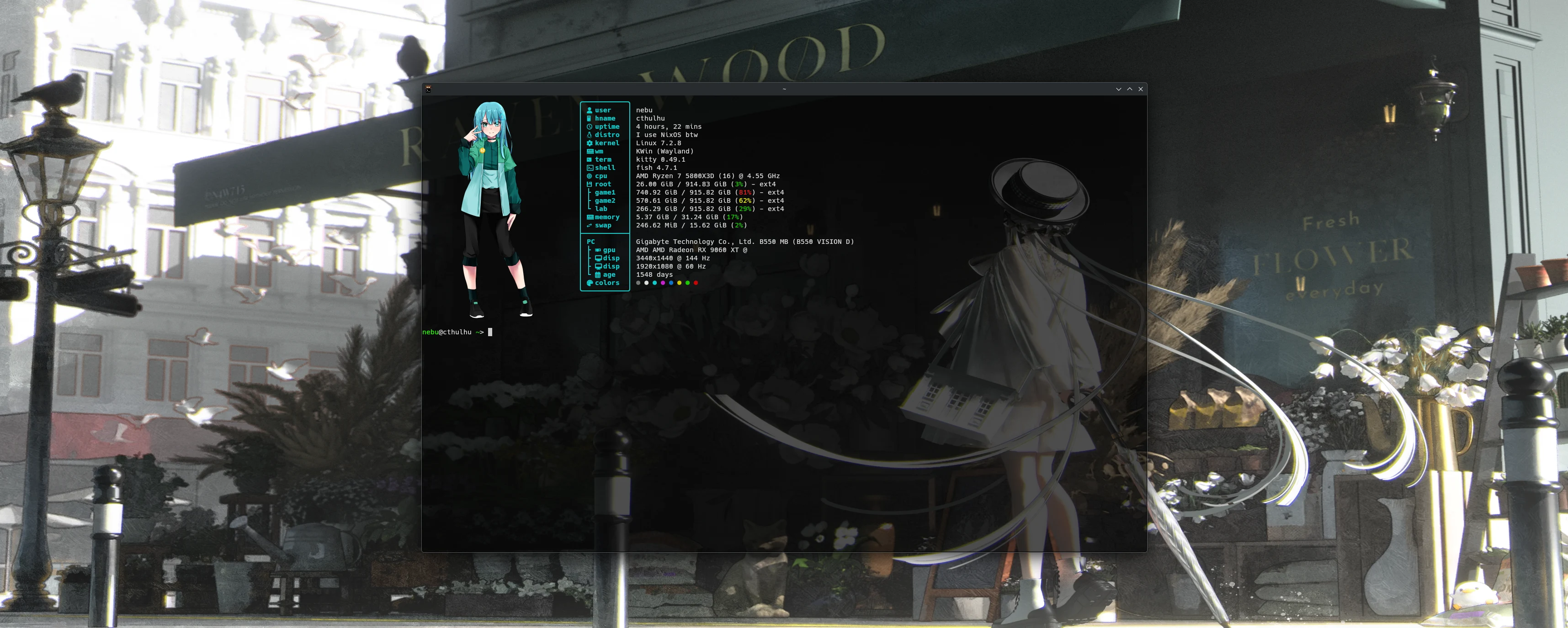
Current Cthulhu has 32 GB RAM, two displays (3440 × 1440 at 144 Hz plus 1920 × 1080 at 60 Hz), one NVMe for the OS, two SATA SSDs for games and another NVMe for Homelab. I am not trying to buy the largest number on every specification sheet; I want a machine suited to the work I actually do.
Interactive timeline: the same curiosity, changing machines
CTHULHU CHRONICLES / TIMELINE
Filter the eras
- around 1996Slackware: earliest Linux memory, a lot of confusion and curiosity.
- 1990s / uncertain dateOS/2 Warp 4 as a birthday wish; fascination with alternatives.
- 2000s / uncertain chronologySUSE cover discs, demonstrating Knoppix, trying Ubuntu. No invented order.
- by 2013Cthulhu with Linux Mint and Windows dual-boot; possible Athlon 64 X2.
- later / dates uncertaini7-7700K / GTX 970, then Ryzen 5800X3D / RTX 3060 Ti, Gentoo / XMonad and permanent Linux-only computing.
- 2026Arch / Sway as an experiment; NixOS / Plasma 6, RX 9060 XT and the documented modern workstation.
Why NixOS and Plasma today, when XMonad is still my favorite
XMonad is my favorite window manager. Sway was something I simply wanted to try. I like Arch, Gentoo and Debian. With NixOS I enjoy its declarative configuration.nix approach: a system described reproducibly in code. It is another unfamiliar idea worth understanding.
But when I turn on the computer after a couple of days, make some tea and sit down to write a tutorial, I do not want to spend the evening studying upgrades or fixing my status bar. Plasma 6 makes the browser, GitHub, image editing, Kdenlive and site development straightforward. I brought most of my familiar XMonad and Sway keyboard shortcuts along. The workflow stays; the desktop changes.
A workstation should get work done – and still inspire curiosity
I now use Cthulhu for writing, websites, personal projects, video editing, development and games. Odd operating systems, old UNIX workstations and unnecessary hardware experiments still interest me. That does not contradict wanting a dependable daily workstation.
My white Radeon, however, added an entirely different chapter: black screens, a GPU fan at full speed and a very long investigation. That story deserves more than a passing paragraph, so it has its own technical article.
Image credits and historical boundaries
The current workstation photographs and preserved Gentoo/NixOS screenshots are my own Computer Museum records. The clearly labeled Wikimedia Commons examples are not my historical captures; credit and licensing information is given under each picture. External Wikimedia images are loaded from Wikimedia servers. 1996 Slackware is represented only by a schematic illustration because no verified screenshot of my installation survives.
Further resources: my Cthulhu configuration archive, the Slackware archive, Knoppix, NixOS and the linked Commons file pages. My timeline prior to 2013 remains based on personal recollection.