Cthulhu
AMD Ryzen 7 5800X3D, Gigabyte B550 VISION D, 32 GiB installed memory detected through SMBIOS and 57 PCI devices reported by boringfetch.
An independent desktop operating system built from scratch — not Linux, not BSD and not a wrapper around another kernel. BoringOS now boots on the real Cthulhu machine with independently owned xHCI controllers, enumerates the real Genesys Logic USB hub and receives movement from the real ROCCAT mouse behind it. That physical input moves the existing software cursor and changes BoringWM focus between live windows as the pointer crosses them. The proven BoringFS, reboot and ACPI S5 lifecycle remains intact.boring is not a bug. it's the entire operating system now.
The physically accepted M66 runtime is frozen at 8ccd618dfc4e8163821de552a3c912bab4e6f36a. Its 96 MiB USB image has SHA-256 84dfb521c2359364ba2f3f78718b686638d81f3d07f35050f32e5a2f91bd0c61. On Cthulhu the real hub-connected mouse visibly moves the cursor and BoringWM pointer hit-testing changes focus between two live windows.
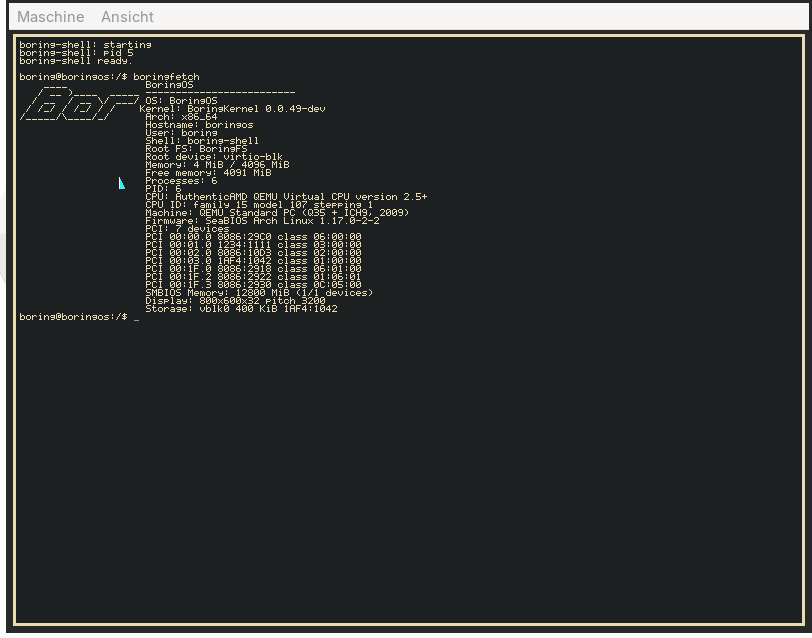
Cthulhu boots into BoringWM with the existing durable USB root and now also proves multiple xHCI controllers, real hub enumeration and a real downstream mouse reaching the Ring3 desktop.
AMD Ryzen 7 5800X3D, Gigabyte B550 VISION D, 32 GiB installed memory detected through SMBIOS and 57 PCI devices reported by boringfetch.
The direct Holtek keyboard and the ROCCAT mouse behind a real Genesys hub reach BoringOS through its own xHCI/HID stack. Mouse movement drives the cursor and live-window pointer focus.
reboot performs a real hardware reset and firmware re-entry. shutdown performs a real ACPI S5 power-off after storage synchronization.
PID 1 starts the Ring3 display stack from BoringFS. There is no X11 or Wayland underneath it.
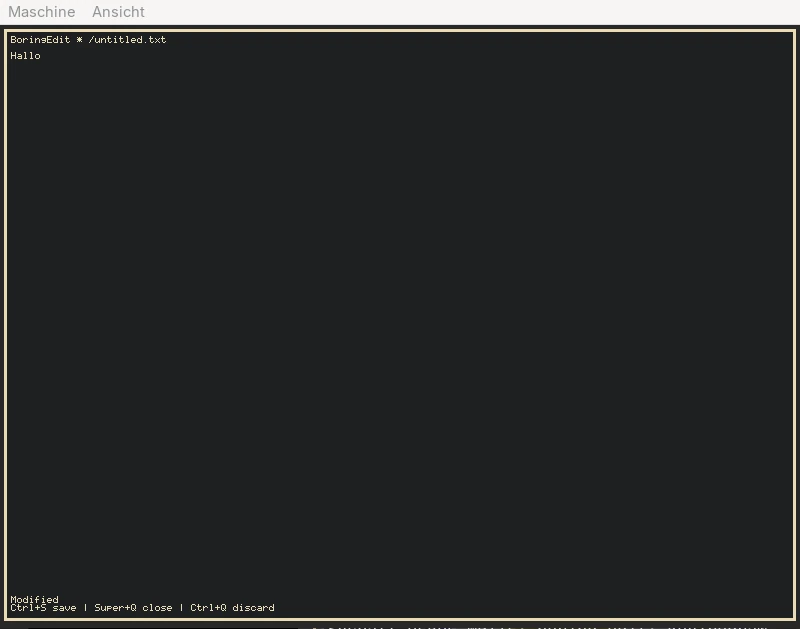
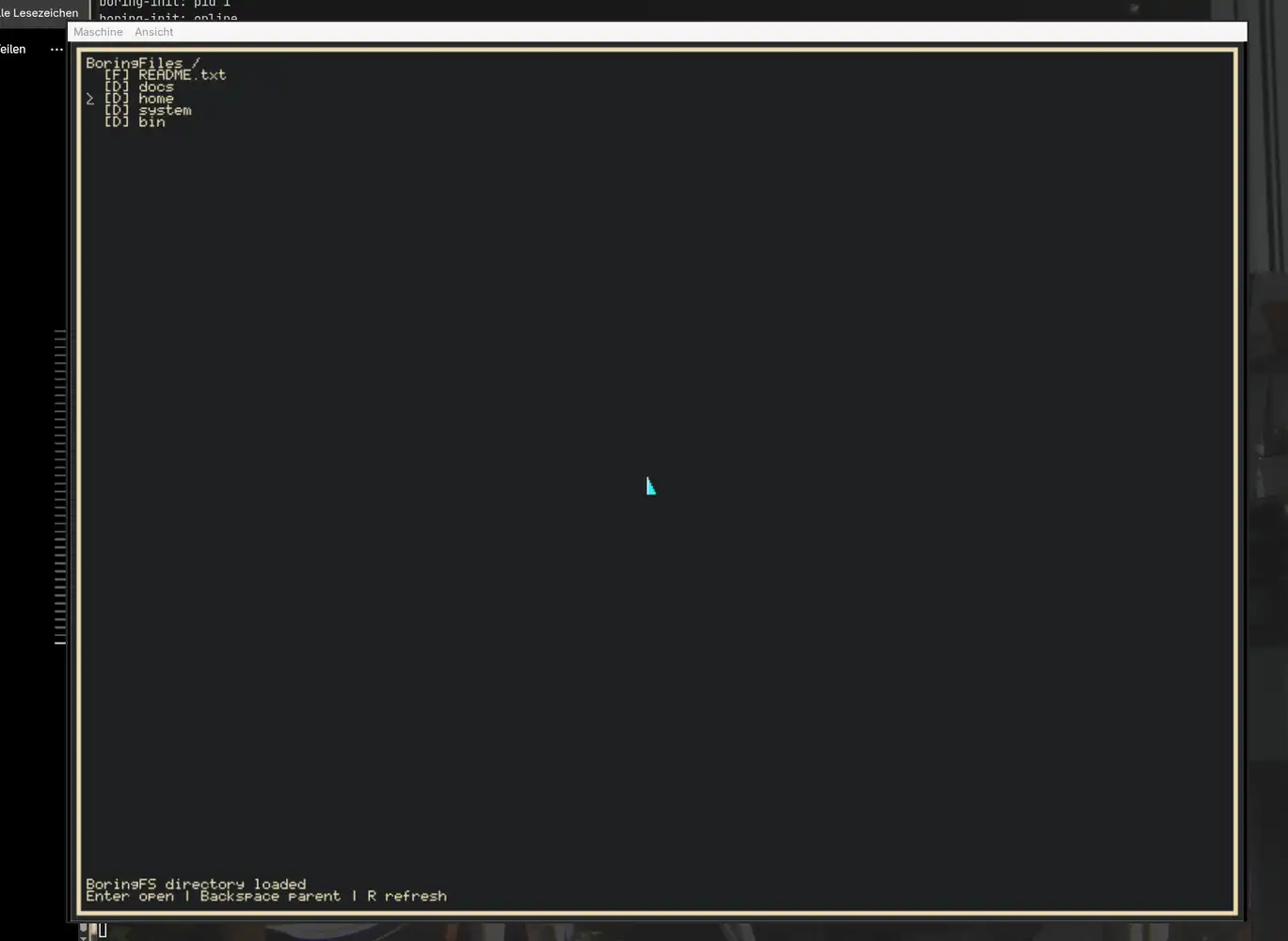
Physical shortcuts include Super+Return, Super+E, Super+F and Super+Q. M62 also physically proved seven terminals plus Edit and Files, full close-down and clean capacity reuse.
M64 removed the single-controller assumption, M65 added bounded downstream hub topology and M66 proves the complete physical path on Cthulhu. M63 remains the separate durability baseline for USB Mass Storage and persistent BoringFS.
BoringOS currently composes the desktop on the CPU and presents into the firmware/Limine framebuffer. The GPU scans that framebuffer out to the monitor, but BoringOS does not yet program AMD graphics hardware itself.
BoringFS is BoringOS's own filesystem. M63 physically proves mkdir/touch/write on the USB root, real reboot, a second successful mount and the original data still present afterwards.
Own codec, validator, formatter, boringfsck, kernel mount support and writable operation.
xHCI USB Mass Storage, Bulk/BOT/SCSI and the fixed BoringFS slice are physically reached on Cthulhu.
Bounded synchronous AHCI/SATA read, write and flush support remains verified alongside VirtIO reference storage.
M61 proved the desktop, M62 capacity, M63 durability/power and M64–M66 now close the multi-xHCI → hub → real mouse chain on physical Cthulhu.
USB-root boot, real BoringWM, keyboard, native apps and persistent empty desktop.
Dynamic runtime objects, 64/64 policy limits and physical multi-application churn beyond the old fixed ceiling.
Durable USB writes, real reboot, second boot with data intact and real ACPI S5 shutdown.
Independent controllers, real Genesys hub enumeration and the real ROCCAT mouse driving cursor movement and pointer focus.
Add bounded typematic repeat so Backspace, arrows and ordinary keys repeat naturally while held without repeating WM launcher shortcuts.
Move beyond the current 800×600 firmware framebuffer while keeping the proven software-rendered desktop.
Optimize software presentation, use the installed 32 GiB more meaningfully and only much later build native GPU support.
The physical machine is now exposing exactly which bootstrap assumptions should be removed next.
The old fixed arrays are gone. Current policy limits are 64 processes / 64 tasks, with 16 BoringWM clients and 16 WM/display IPC peers.
Held USB keys do not typematically repeat yet; Backspace currently needs one press per deletion. This is input polish, not a topology failure.
Firmware framebuffer + CPU composition. No native AMD/NVIDIA/Intel GPU driver yet.
No networking, audio, NVMe or SMP runtime yet. BoringOS still prefers a truthful small system over pretend support.
main now contains the physically accepted M66 runtime plus documentation. The exact runtime is retained separately as an immutable-by-policy freeze branch.