In this article
- What IBM actually announced in 2026
- An ISA is a contract with software
- Why IBM Z software has its own world
- What AArch64 brings to the picture
- One core design, two native instruction sets
- Two programs you can inspect instruction by instruction
- A transaction talks to a separate Arm service
- AI near transactions: motivation, not a magic shortcut
- Telum II, Spyre and the availability question
- What remains open
- Try the concept yourself
- Sources and implementation references
A processor core is usually introduced through a single architectural identity: this one runs x86-64 software, that one runs AArch64, another implements IBM Z. Different generations can implement the same instruction set in very different ways, but the software contract gives each family a recognizable boundary. IBM’s August 2026 announcement makes that boundary unusually interesting: a future core design is intended to support both IBM Z and Arm instructions natively.
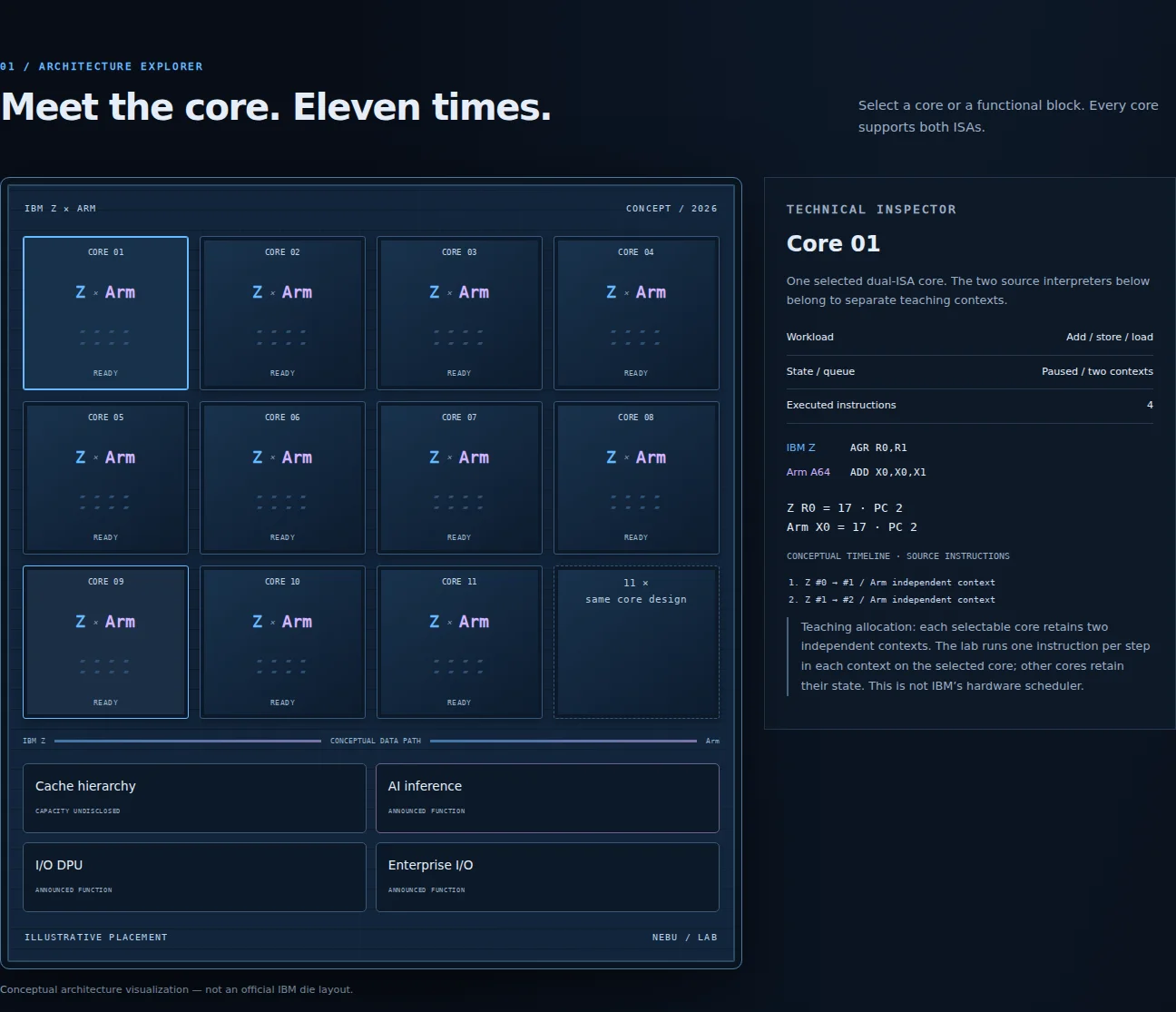
That is the subject of my new Dual-ISA Processor Lab. Select a core, step through two small programs, inspect their registers and follow a fictional service request. The exhibit separates published architecture claims from its own teaching machinery. Understanding that distinction is part of understanding the processor itself.
What IBM actually announced in 2026
IBM and Arm announced their collaboration on April 2, 2026. Its stated areas included virtualization, enterprise requirements and software ecosystem growth. On August 24, at Hot Chips, IBM then described a future processor with native support for both architectures in each core. Arm’s accompanying account confirms the per-core approach. This is a concrete distinction from putting dedicated Arm cores beside dedicated Z cores. [1] [2] [3]
The published design targets are eleven high-performance cores, a 2-nm technology node and operation above 5.7 GHz, alongside integrated inference acceleration, an on-chip I/O DPU and a large cache architecture. They describe an announced design, not measurements from our lab. Neither those specifications nor the cited sources establish a commercial launch date. [2]
Beyond that short factual foundation, this article explains general architecture concepts and the choices in my own implementation. It does not infer a hidden pipeline from a promotional diagram. A useful educational reconstruction should make its assumptions inspectable, just as it makes its registers inspectable.
An ISA is a contract with software
An instruction set architecture defines what a processor presents to machine-level software. Arithmetic instructions are the most visible part, but the contract also includes registers, addressing, condition information and rules governing memory operations. Privileged architecture adds mechanisms that operating systems need. An ISA is therefore much more than a list of verbs such as ADD and LOAD.
Consider an instruction that adds two 64-bit values. Software needs to know which operands it reads, where the result goes and what happens when the mathematical sum is too large. Does the instruction update condition information? Can it read memory directly? Which exceptions are possible? The answers affect the compiler and the correctness of the program, even when two processors both seem to be “adding numbers.”
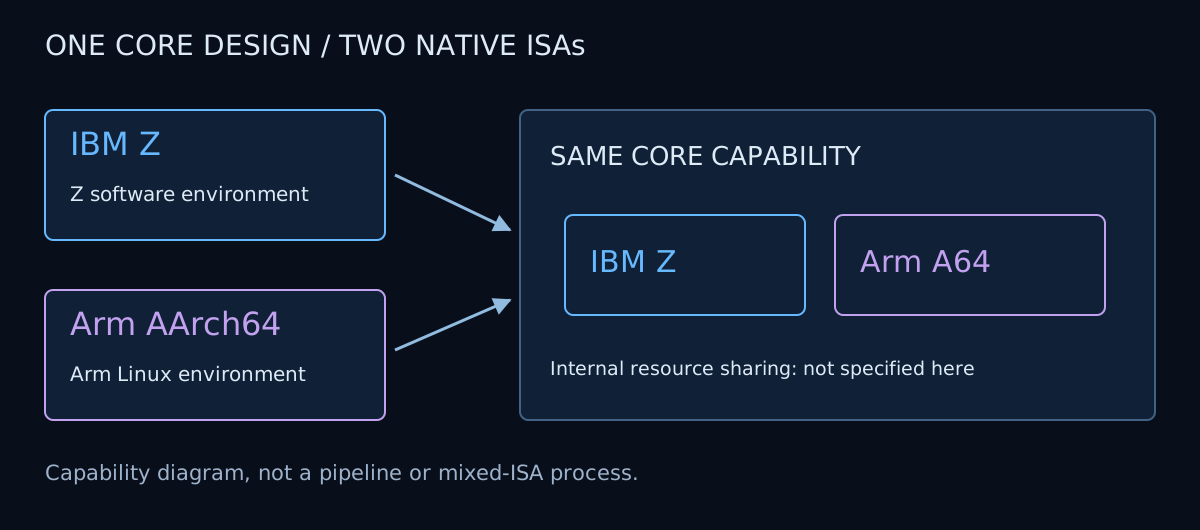
A physical implementation can use decoding, pipelines, caches and execution units to satisfy that contract. Several implementations can satisfy the same ISA while differing in latency, power and organization. Conversely, native support for two ISAs does not by itself reveal which internal resources are shared. Supporting a contract and publishing the machinery that fulfills it are different things.
Compatibility also has layers. A program’s instruction bytes must be understood, but its operating-system services, libraries and application binary interface must match its execution environment too. An AArch64 executable cannot become a z/OS application merely because both instruction sets are supported by the underlying core.
Why IBM Z software has its own world
IBM Z is associated with long-lived enterprise applications and transaction processing. A transaction is not simply a fast arithmetic operation. It is a coordinated change to business state: an account update, inventory movement or reservation must remain meaningful despite errors and concurrent requests. The processor is one part of a stack that includes storage, databases, operating systems and operations.
z/OS and Linux on IBM Z are distinct software environments. Sharing the IBM Z instruction architecture does not make their program interfaces interchangeable. For someone coming from desktop Linux, that is a useful reminder: “runs on this CPU” and “runs in this operating system” are separate requirements. The architecture documentation provides the machine-level reference, while an operating environment supplies the rest. [4]
The exhibit represents the transaction side with a labeled Z application, not a running z/OS instance. There are no channels, database logs or recovery guarantees behind the animation. Its purpose is narrower: show where a transaction application asks another environment for a result, and why that exchange needs an explicit interface.
What AArch64 brings to the picture
AArch64 is Arm’s 64-bit execution state; A64 is its instruction set. In the lab, the Arm listing uses 64-bit X registers and a deliberately small set of instructions. It does not cover every optional architecture feature, vector extension, privilege level or operating-system convention. Those distinctions matter when evaluating whether a particular binary and its dependencies are supported. [5]
For an organization, software availability can be as important as a processor’s arithmetic throughput. A supporting application may already be developed, packaged and tested for Arm Linux. Bringing that environment nearer to a transaction system could change deployment choices. It still requires compatible libraries, operational support and a supported operating system; an instruction set cannot supply those automatically.
A container is a good example of this boundary. Packaging an application and its userspace dependencies does not remove its machine architecture. A container image containing AArch64 binaries needs an appropriate execution environment. A multi-architecture image index can select a suitable build; it is not itself an instruction translator.
One core design, two native instruction sets
The crucial published statement is that each core supports both architectures natively. Arm likewise describes the two software environments coexisting rather than Arm being treated as a separate subsystem. That identifies the architectural capability. It does not give us a complete account of resource arbitration, instruction decoding or operating-system integration. [3]
My visualization repeats the same Z × Arm identity eleven times. Selecting a tile changes which pair of teaching contexts you inspect. You can run one pair, select another core and find a fresh pair of registers. Returning to the earlier tile restores its state. This is a way to explain capability and context, not a prediction of IBM’s dispatch algorithm.
In particular, one visible lab step advances one instruction in each of two independent JavaScript interpreters. That pairing exists to make comparison easy. It does not claim that two hardware instructions issue together, that both environments share registers, or that a process can change ISA by jumping into a different binary. The real implementation must preserve the architectural state expected by each supported environment.
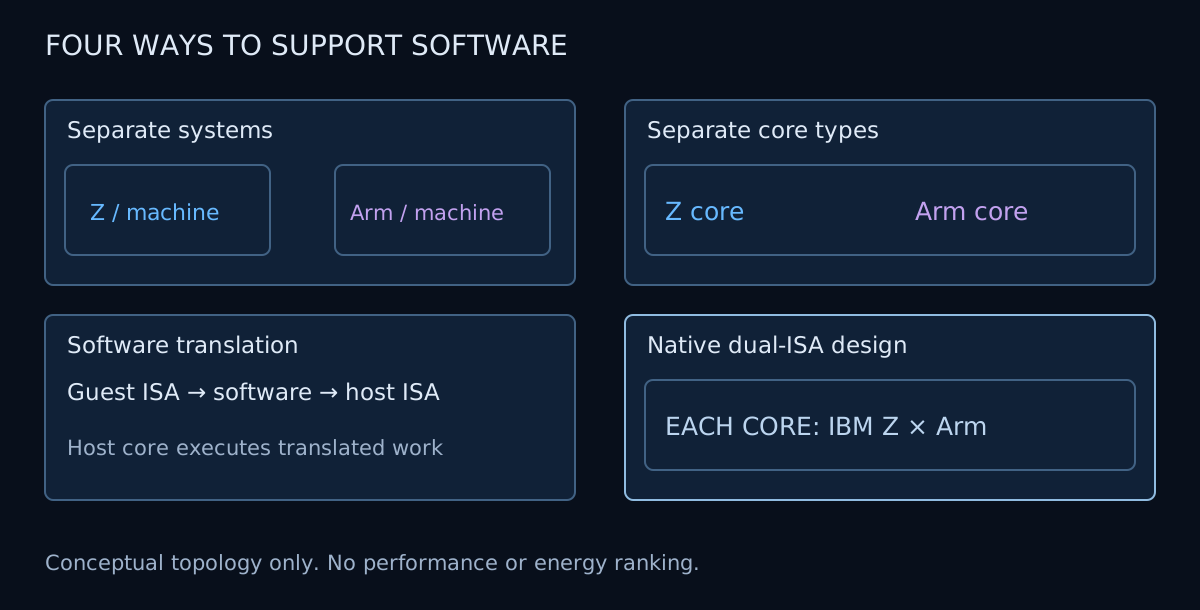
Four selectable comparison diagrams make the alternatives visible: different machines; dedicated core types on one chip; an emulation or translation layer; and native dual-ISA capability per core. None is assigned an invented speed score. These categories describe where compatibility is implemented, not a universal ranking of useful computer designs.
Two programs you can inspect instruction by instruction
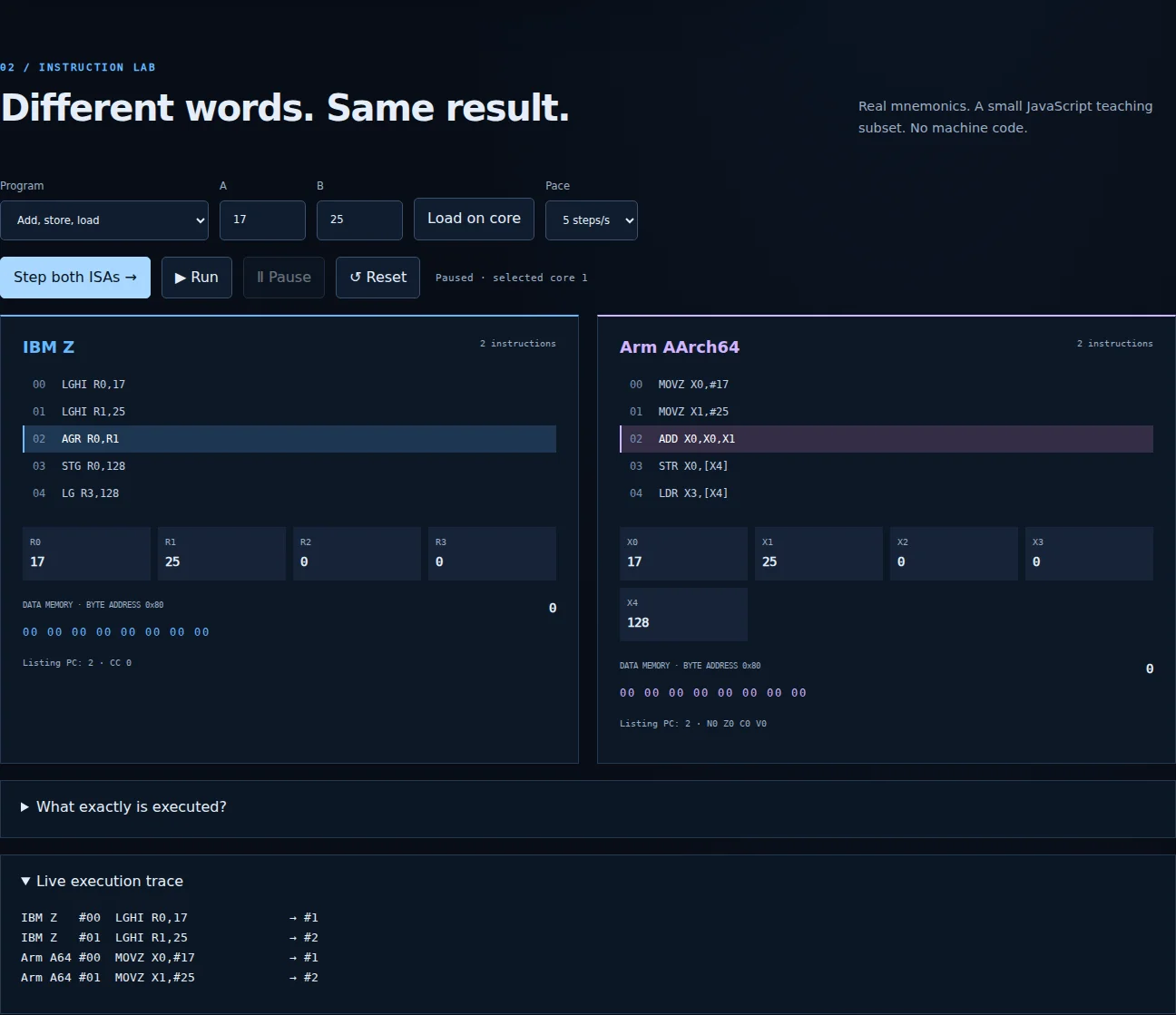
The first teaching exercise adds 17 and 25, stores the result at byte address 128 and loads it into another register. On IBM Z, the listing uses LGHI to load small signed immediate values, AGR for register addition, STG to store a 64-bit value and LG to read it back. Arm uses MOVZ, ADD, STR and LDR. These are documented mnemonics; only the operand forms used by the lab are implemented. [4] [5]
The similarity of the answer hides useful differences. AGR updates the modeled IBM condition code. The Arm ADD form shown does not update flags. The Z store uses an absolute displacement with no base register, whereas the Arm example uses X4, preinitialized by the teaching harness to 128, as its address register. Registers contain values; the data address selects bytes; the listing PC selects a source instruction.
Both memory panels end with the number 42, but the displayed byte sequences differ. The Z model stores the most significant byte first. The Arm example chooses little-endian data order and stores the least significant byte first. This is an observation about our chosen teaching configurations, not a claim about an undocumented cross-environment memory arrangement in the future chip.
The second exercise compares the sum with 42. CGR and BRC implement the Z decision; CMP and B.EQ implement the Arm decision. When the comparison is equal, execution skips an instruction that would replace the result with zero. Change an input, reload the program and observe the other path. The same structured problem now has two inspectable implementations.
BRC uses a mask against the IBM condition code; mask 8 selects equality. Arm CMP records condition flags, and B.EQ tests the zero flag. The teaching implementation uses JavaScript BigInt for 64-bit arithmetic, allowing wraparound and comparison behavior to be tested without losing integer precision. No instruction encoding or binary decoder is invented.
The PC shown is a zero-based listing index. A taken branch changes that index; it is not a byte displacement. Reaching the end stops the harness rather than executing a fictional HALT instruction. These constraints keep a small source-level interpreter honest. They also explain why an instruction counter here is not a hardware timing measurement.
A transaction talks to a separate Arm service
The enterprise demonstration starts with a fictional amount and a cross-region checkbox. A Z-side application validates that request, sends a structured service message, receives a risk response and completes the workflow. The Arm-side service applies a transparent deterministic rule: ten score points per complete thousand demo units, plus twenty-five for a cross-region request, capped at one hundred.
A score of fifty or more produces “review”; a lower score produces “approve.” For 2,400 units without the cross-region flag, the score is twenty. With that flag, it is forty-five. At 5,000 units without the flag, the result reaches the review threshold. These numbers are properties of an original teaching rule. They are not measured fraud probabilities, bank policy or an IBM model.
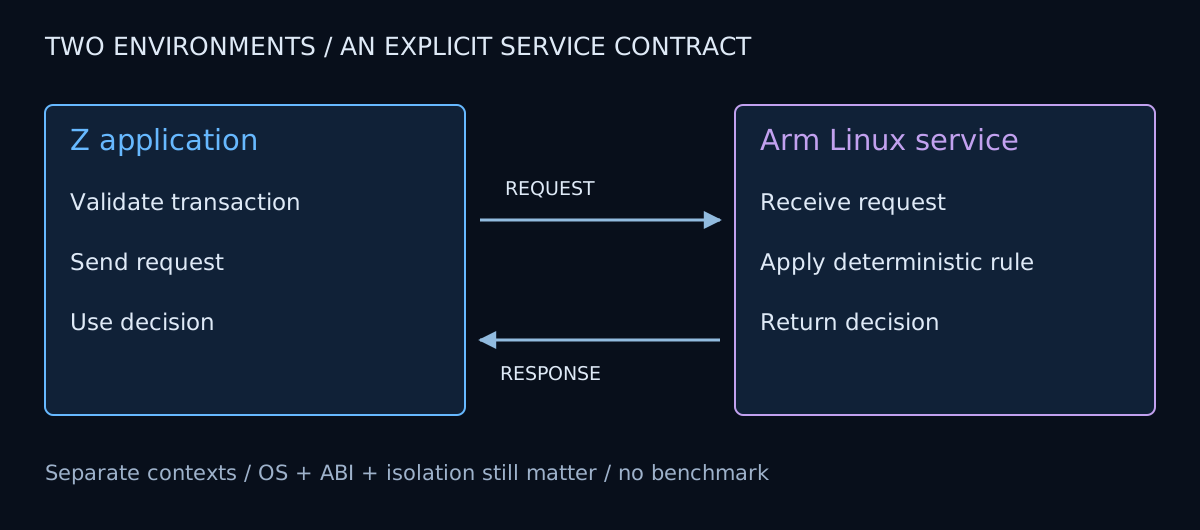
Stepping through the workflow lets you inspect the actual request and response objects. Switching to the separate-platform comparison changes the described transport boundary. It does not secretly change the scoring rule or print a fabricated latency advantage. The distinction is placement: separate machines require a cross-machine path; an integrated-platform concept places the environments within a different system boundary.
Even on one platform, an interface still needs serialization, authorization, failure handling and an agreed meaning for its fields. Native instruction support does not make incompatible application binary interfaces disappear. The lab deliberately shows distinct software environments exchanging messages, rather than one process executing arbitrary binaries from both architectures.
AI near transactions: motivation, not a magic shortcut
IBM’s announcement includes integrated inference acceleration. The motivation is understandable: a decision can be useful while a transaction is being evaluated, rather than in a report generated afterwards. IBM’s follow-up article frames the design around bringing modern workloads closer to enterprise data. That is the stated direction; its value for a particular application still needs to be assessed. [6]
As a general systems argument, fewer deployment boundaries can change where data is serialized, transferred, secured and monitored. But some costs remain even when components are nearby. A service must still obtain the right features, run a suitable model and return a result the transaction can use. The slowest part may lie outside the processor entirely.
An inference accelerator is specialized hardware. It is not simply a new name for ordinary CPU instructions, and it does not make every AI workload identical. Model size, operators, numeric formats, software support and batching all influence suitability. Nothing in this exhibit establishes that GPUs become unnecessary or that all existing models execute unchanged.
Our deterministic rule is intentionally separate from the illustrated AI block. You can verify every score with arithmetic. This avoids making a small browser demonstration look like a trained fraud model, while still showing the service interaction that an inference-backed implementation might need.
Telum II, Spyre and the availability question
IBM z17 is the existing generation powered by Telum II. Spyre adds complementary acceleration in that ecosystem. IBM’s z17 launch material belongs to that product story, whereas the August 2026 dual-architecture announcement concerns future platforms. The lab therefore does not label its processor “z17” or “Telum II.” [7]
An architecture announcement, working silicon, supported operating systems and a generally available commercial system are different milestones. The cited 2026 material does not establish a launch in 2027. A date can be plausible in discussion and still be unsupported as a publication claim. Until an authoritative availability announcement exists, “future design” is the accurate description here.
What remains open
The cited sources do not provide enough detail to reproduce the processor. Questions include the supported architecture features, software enablement, virtualization interfaces, cache organization, resource sharing and workload isolation. Some aspects may be documented elsewhere as the platform develops; the exhibit does not fill those gaps with an invented floorplan.
Frequency alone cannot answer application-performance questions. Work completed per instruction, dependencies, cache misses, memory traffic and operating-system behavior all affect the outcome. A fair evaluation would require real workloads, documented configurations and reproducible measurements. Counting animated source instructions in JavaScript provides none of that evidence.
There are equally practical software questions: which distributions and libraries are supported, how updates are delivered, how failures are diagnosed and how environments are managed together. Those issues determine whether a new architectural capability becomes a useful production platform. They deserve attention alongside the striking fact that two instruction sets can be supported in the same core design.
Try the concept yourself
Start with core 01 and the addition exercise. Step through both listings until they store 42, then compare the byte order in memory. Reset, choose the branch exercise and change an operand. Follow the program counter past the instruction that is skipped only when the sum equals 42. Finally, submit a synthetic transaction and inspect each service message.
The processor illustration, teaching interpreters and workflow all serve that one subject: the relationship between software contracts and hardware capability. Every calculation happens locally in your browser. Open the Dual-ISA Processor Lab →
Sources and implementation references
- IBM: strategic collaboration with Arm, April 2, 2026.
- IBM: next-generation dual-architecture processor, August 24, 2026. Primary specification and future-direction statement.
- Arm: expanding the ecosystem for enterprise computing, August 24, 2026.
- IBM z/Architecture Principles of Operation, SA22-7832-02; instruction semantics. Also IBM HLASM instruction table.
- Arm A-profile A64 Instruction Set Architecture, DDI0602, March 2026 edition; instruction forms and condition flags.
- IBM Think: At Hot Chips, a chip that speaks both mainframe and AI, August 28, 2026.
- IBM z17 announcement, April 8, 2025; existing generation and Telum II distinction.
Original diagrams and browser captures: Dennis Hilk, October 16, 2026. Conceptual layout, not IBM CAD or a die photograph. Independent project, not endorsed by IBM or Arm. Product and architecture names belong to their respective trademark owners.